

Call us
+86-18703630069
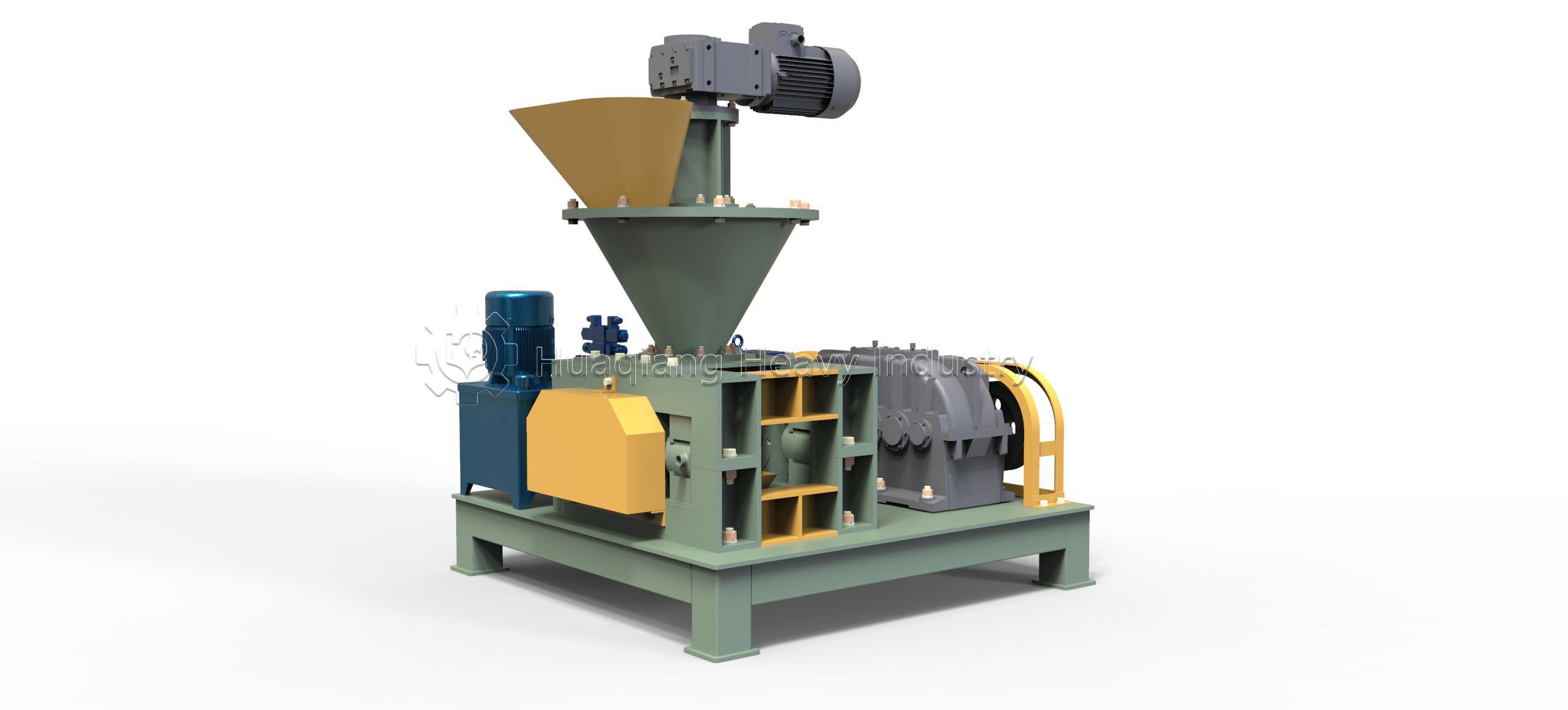
Hydraulic Roller Granulator
The hydraulic double-roller granulator is a core piece of equipment for dry granulation in industries such as fertilizer, chemicals, and mining. Operating on the principle of "high-pressure roller extrusion combined with automatic hydraulic compensation," the machine enables direct material forming without the need for drying. Unlike traditional wet granulation systems, this equipment utilizes a purely dry extrusion process that requires no humidification; this fundamentally simplifies the production workflow, eliminates the generation of wastewater and waste gas, and meets environmental protection standards. Thanks to its multiple advantages—including dry forming, energy efficiency, environmental friendliness, process simplicity, broad adaptability, and high cost-effectiveness—the hydraulic double-roller granulator has become the mainstream choice for dry granulation processes.
Hardware Configuration and Component Functions
The hardware components of the hydraulic double-roll granulator primarily include:
(I) Roller assembly: The core operating component, featuring a dual-roller counter-extrusion design. The roller surfaces are made of wear-resistant alloy and precision-machined with uniform patterns; granule specifications can be customized as required.
(II) Hydraulic drive system: Utilizes an automatic pressure-stabilizing design that employs a hydraulic pump to compensate for roller gap pressure in real-time; equipped with overload protection.
(III) Feed regulation mechanism: Features a variable-frequency speed control design for precise regulation of the material feed rate.
(IV) Frame: A robust cast or welded structure that supports all components.
(V) Intelligent control system: A PLC control cabinet that allows for the adjustment of pressure, roller gap, and feed rate.
Competitive Comparison and Unique Advantages
Hydraulic roller granulator has significant advantages compared with other granulation equipment:
Compared with disc granulator/drum granulator: traditional wet granulation materials must go through drying and cooling processes after being formed, which requires high energy consumption and cumbersome processes. The hydraulic double-roller granulator uses a dry method to form the granules in one go, eliminating the need for drying and reducing unit energy consumption by more than 40%.
Compared with ordinary double-roller granulators: the hydraulic system provides a more stable and adjustable extrusion force; it has an overload protection function and automatically relieves pressure when encountering hard objects.
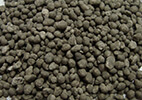
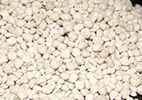
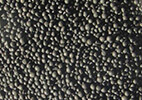
Core advantages: ① Dry molding - no need to add water, no binder, no need to dry; ② Pressure controllable - hydraulic automatic pressure stabilization technology can accurately adjust the extrusion pressure; ③ High-quality particles - high density of finished particles and compressive strength ≥ 20N/pellet ; ④Environmental protection and efficiency improvement - fully enclosed operation design to reduce dust leakage; ⑤Convenient maintenance - the rollers are removable and made of wear-resistant material, and the annual maintenance cost is only 3,000-5,000 yuan; ⑥Simple process - only 1-2 hours from feeding to finished product.

Application Landscape and Audience Distribution
Hydraulic double-roller granulators serve a wide range of applications and user groups:
Organic fertilizer manufacturers: Serving as core equipment for dry granulation, these machines directly process and shape materials such as decomposed livestock manure, crop straw, and spent mushroom substrate into products like pure organic fertilizer and bio-organic fertilizer.
Compound fertilizer manufacturers: Used for granulating organic-inorganic mixed fertilizers and compound fertilizers, ensuring a balanced distribution of nutrients.
Chemical raw material processors: Suitable for shaping inorganic materials such as urea and potassium sulfate; also used to granulate powdered materials like antioxidants and zinc oxide, thereby preventing dust pollution.
Large-scale livestock farms: Integrated with fermentation and crushing equipment to enable on-site manure treatment and resource recovery.
Solid waste resource utilization centers: Capable of converting industrial waste—such as fly ash, sludge, and slag—into granules.
Mining and metallurgical enterprises: Capable of processing materials such as slag and converter dust.
Scope of Materials and Production Capacity Overview
The hydraulic double-roller granulator has extremely wide adaptability to raw materials. Fertilizer raw materials: potassium sulfate, potassium chloride, urea, ammonium bicarbonate, ammonium chloride, potassium nitrate, monoammonium phosphate, diammonium phosphate, ammonium sulfate, and ammonium bicarbonate. Organic materials: decomposed organic materials such as chicken manure, cow manure, straw powder, etc. Chemical powder: antioxidant, zinc oxide, metal powder, white carbon black, graphite, carbon black, etc. Industrial waste: slag, fly ash, desulfurization gypsum, phosphogypsum, etc. In terms of production capacity, it ranges from DGZ-1 type 1-1.5 tons/hour to HD-600 type 10-20 tons/hour. The granulation rate is ≥85% and the granule strength is 6-20N.
Operational Mechanism and Granulation Principle
The operating mechanism of the hydraulic twin-roll granulator is based on the principle of "high-pressure twin-roll extrusion combined with automatic hydraulic compensation." Material enters the gap between the twin rolls and rapidly agglomerates under high-pressure extrusion, forming granules with high strength and uniform density; the granulation rate exceeds 95%. The process requires minimal binder, resulting in smooth, uniform granules with a low breakage rate. The hydraulic system delivers stable extrusion pressure tailored to material characteristics (adjustable as needed). The inclusion of a fully automatic hydraulic pressure regulation system is a key feature distinguishing this equipment from standard mechanical twin-roll granulators.
Production Line Coordination and System Integration
The hydraulic double-roller granulator serves as the core granulation unit within the production line. Upstream equipment—such as crushers, proportioning scales, and mixers—can be integrated with the machine, while downstream components like crushers, vibrating screens, and packaging scales can also be incorporated. The unit seamlessly connects with crushing, drying, and screening equipment to form a complete production line. Its feeding system utilizes variable-frequency, stepless speed control, ensuring a high level of automation. Designed for continuous 24-hour operation, the equipment can be paired with cooling and packaging systems to create a fully integrated production line.