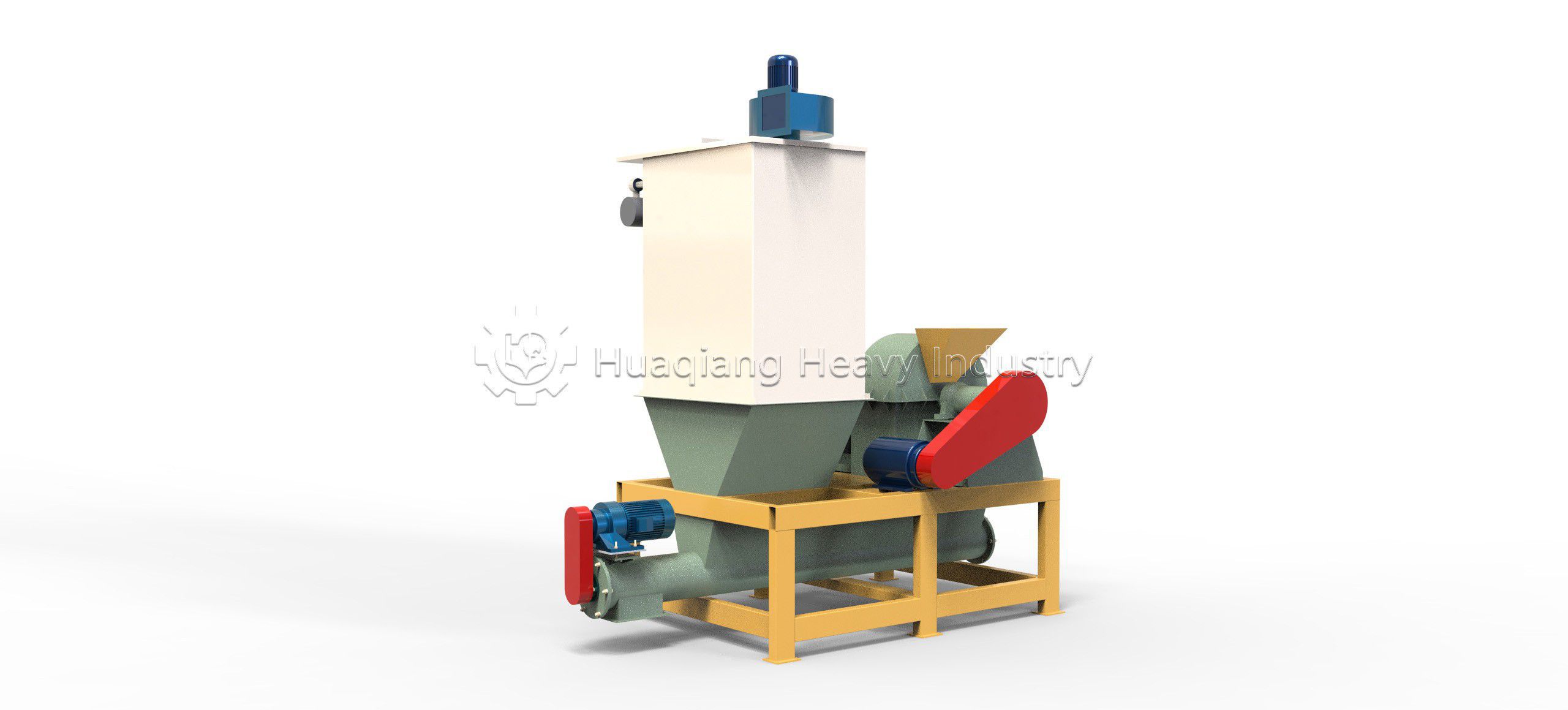
The cage crusher is one of the most widely used pulverizing devices in fields such as fertilizer production, organic waste treatment, and chemical processing. Utilizing high-speed, counter-rotating dual cages to achieve impact-based crushing, the equipment combines the advantages of high impact efficiency, a high proportion of fine powder output, excellent sealing, and smooth operation. Thanks to its high crushing efficiency, uniform particle size, tolerance for high moisture content, and ease of cleaning and maintenance, it has become a core piece of equipment for crushing medium-hardness lumps and agglomerated materials in industries including compound fertilizers, organic fertilizers, chemicals, and building materials.
Key components have been specifically optimized to handle the agglomeration tendencies and high moisture content characteristic of fertilizer and chemical raw materials. The crushing rods are manufactured from high-quality steel, and the housing features a fully enclosed design to effectively contain dust. A screw adjustment mechanism facilitates the installation and removal of the cage assembly, simplifying the inspection and replacement of rods, while an optional cyclone dust collection system enables dust-free operation. With low investment and operating costs, the cage crusher offers an efficient and reliable solution for material pulverization across various industries.
The hardware components of the cage mill primarily include:
(I) Dual-cage rotor assembly: The core crushing component of the equipment, comprising a large cage assembly (outer cage) and a small cage assembly (inner cage). Each cage consists of steel discs and steel rods rigidly mounted onto them.
(II) Housing assembly: Includes the upper casing, lower casing, and cover plate. The fully enclosed design effectively controls dust.
(III) Drive assembly: Includes two electric motors, pulleys, and V-belts.
(IV) Feed and discharge assembly: Includes the feed hopper and discharge outlet.
(V) Dust removal assembly: Includes an optional cyclone dust collection unit.
Cage crushers have a wide range of applications and serve diverse industries:
Compound fertilizer manufacturers: Crushing raw materials prone to caking, such as urea, ammonium phosphate, and potash.
Organic fertilizer manufacturers: Crushing semi-moist organic materials—including fermented livestock manure, crop stalks, and spent mushroom substrate.
Chemical enterprises: Crushing raw materials such as kaolin, clay, and bentonite.
Building materials companies: Crushing limestone, dolomite, shale, coal gangue, and similar materials.
Mining enterprises: Crushing industrial slag, dry clay, and other materials.
Feed and food processing companies: Crushing raw materials for animal feed and food products.
Cage crushers are capable of processing various lump and agglomerated materials of medium hardness. These include: fertilizers (urea, ammonium phosphates—MAP and DAP—potassium chloride, potassium sulfate, and compound fertilizers); organic materials (fermented livestock and poultry manure, straw, mushroom residue, distillers' grains, sawdust, and humus); and minerals (kaolin, clay, bentonite, limestone, and dolomite).
The operating mechanism of the cage mill relies on a synergistic pulverization mode combining high-speed counter-rotation of dual cages, multi-stage impact, and inter-particle collision. Two electric motors drive the inner and outer cages to rotate at high speeds in opposite directions. After entering the center of the cages through the feed inlet, the material passes sequentially through the rings of steel rods—from the innermost to the outermost—experiencing alternating impact forces at each stage. Pulverization occurs through three mechanisms: impact by the steel rods, collisions between particles, and impact against the inner wall of the housing. Following this progressive pulverization, the material is discharged from the bottom of the housing.
The cage crusher plays a pivotal role in the production of compound and organic fertilizers. The machine's intake section accepts fermented material clumps or large chunks of chemical fertilizer raw materials, subjecting them to multi-stage impact crushing via dual rotating cages. Once the material reaches the specified particle size—with over 80% of particles measuring less than 0.5 mm—it proceeds to subsequent stages such as proportioning, mixing, and granulation. In compound fertilizer production lines, the cage crusher is typically positioned within the raw material pre-treatment section; in organic fertilizer lines, it is usually located after the fermentation discharge stage but prior to proportioning and mixing. Capable of continuous 24-hour operation, the equipment integrates seamlessly with upstream and downstream machinery to form a complete, automated production line.
Call us directly, submit a sample or email us!