

With the advancement of “dual carbon” goals and increasingly stringent environmental regulations, NPK compound fertilizer production faces growing environmental pressure. Major pollution sources include dust, exhaust gases, wastewater, and noise. Improper handling can not only affect the surrounding environment but also lead to production shutdowns and mandatory rectification.
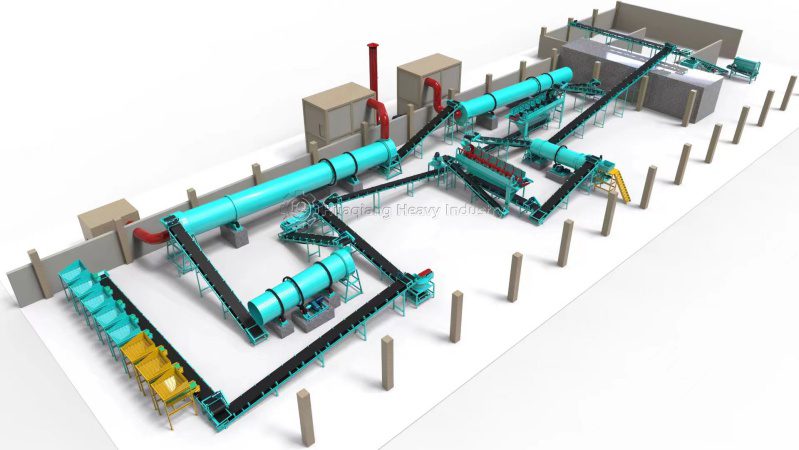
Dust in NPK fertilizer production lines mainly originates from raw material feeding, crushing, mixing, granulation, screening, and packaging processes. Traditional open operations easily lead to uncontrolled emissions. To address this, modern factories commonly employ closed conveying systems with negative pressure suction, concentrating dust-laden gases into cyclone dust collectors for initial filtration, followed by deep purification using pulse bag filters, achieving emission concentrations below 20 mg/m³. High-temperature, high-humidity drying exhaust gases are often treated using a “settling chamber + wet scrubber” combination process, which both cools the gas and removes ammonia.
Regarding wastewater, equipment rinsing water and condensate may contain small amounts of nitrogen and potassium ions. This wastewater needs to be treated in a neutralization and sedimentation tank before being recycled for granulation or cooling systems, achieving zero discharge. Some companies also build rainwater collection ponds to prevent factory runoff pollution.
For noise control in NPK fertilizer production lines, high-noise equipment such as fans and crushers should be equipped with soundproof covers, and the workshop layout should be optimized to reduce noise transmission. Furthermore, optimizing the combustion system (e.g., using low-NOx burners) and recovering waste heat from drying exhaust gases for preheating air can significantly reduce carbon emissions and energy consumption.
In addition, implementing clean production audits and establishing ISO 14001 environmental management systems have become standard practice for leading companies in the NPK fertilizer industry. In the future, green manufacturing will not only be a compliance requirement but also a key to gaining policy support and market trust. Only by integrating environmental protection concepts throughout the entire design, operation, and management process can the NPK fertilizer industry truly achieve sustainable development.