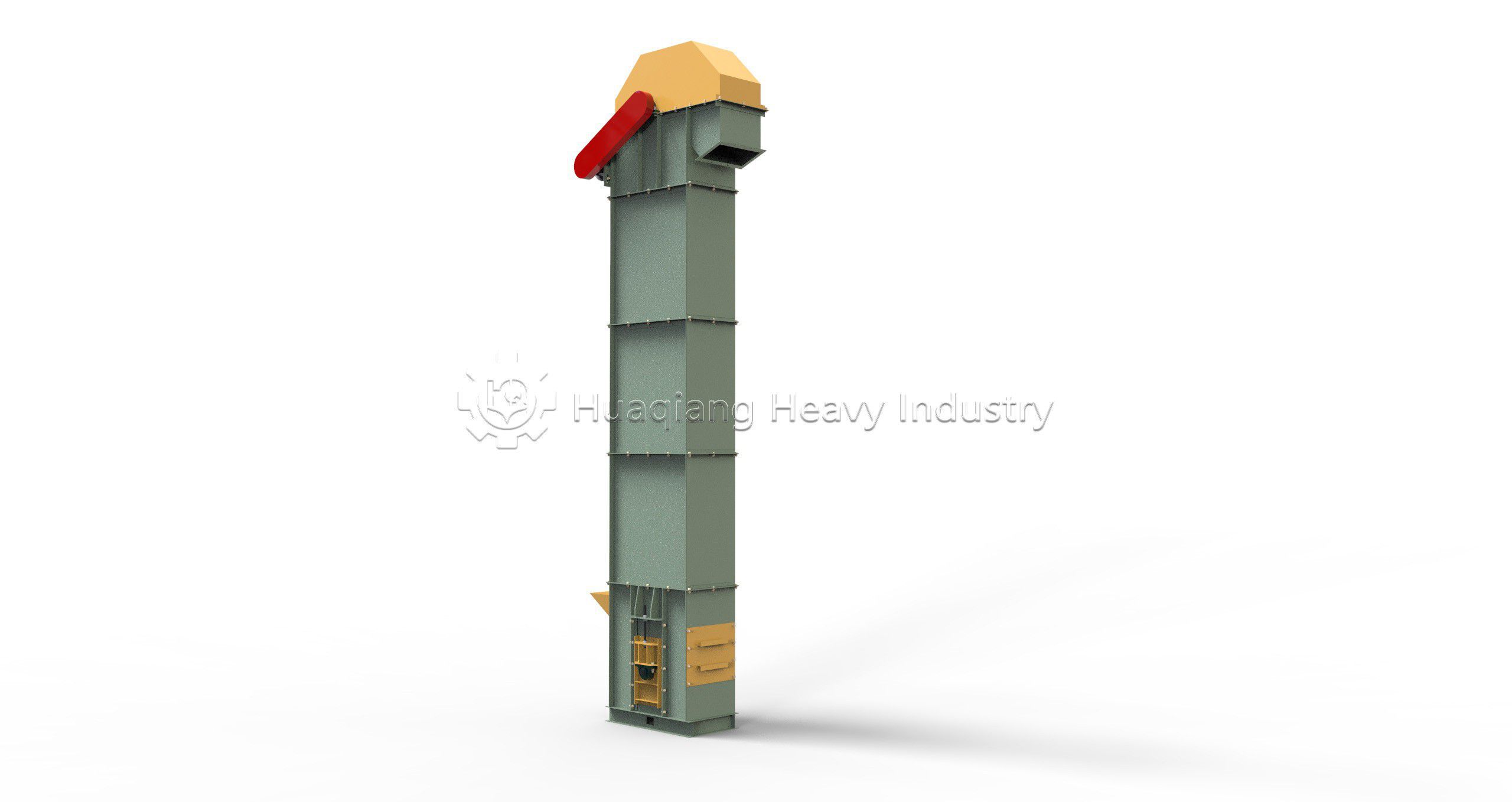
Bucket Elevator

斗式提升机.56

Bucket Elevator

A bucket elevator is a mechanical device designed for the continuous vertical transport of bulk materials—such as powders, granules, and small lumps—using buckets fixed to a traction element. Widely utilized across sectors including construction materials, machinery, chemicals, electric power, grain processing, and light industry, it handles a diverse range of materials such as ore, coal, cement, grain, and fertilizers. Key characteristics of the bucket elevator include a compact structure, high space efficiency, substantial conveying capacity, significant lifting height, and excellent sealing performance.
The value of bucket elevators in industrial production extends beyond the efficiency of vertical material transport; they play a crucial role in ensuring the continuous and automated operation of production lines. They are widely employed in the fertilizer industry—particularly for compound and organic fertilizers—to transport materials vertically from lower to higher elevations. Thanks to their minimal footprint, high lifting capacity, large throughput, low energy consumption, and superior sealing, bucket elevators have become indispensable equipment for vertical transport in modern industrial production.

Structural composition of the equipment

The bucket elevator primarily consists of traction elements (rubber belts or chains), buckets, a drive unit, head and tail pulleys (or sprockets), a tensioning device, and the casing. The complete machine comprises an upper housing, a drive unit, intermediate casing sections, an inspection door, an inlet, and an outlet. The entire assembly forms an enclosed structure defined by the external casing.

Application scope of the equipment

Bucket elevators are widely used across various industries requiring the vertical transport of materials. In fertilizer production: for the vertical transport of materials such as compound fertilizers, organic fertilizers, bio-fertilizers, and controlled-release fertilizers. In mining and metallurgy: for conveying materials such as ore, coal, cement, crushed stone, sand, and clay. In the grain and food sectors: for conveying grain, cereals, animal feed, and similar materials. In construction materials and chemicals: for conveying cement, fertilizers, chemical raw materials, and other substances. In the power and environmental protection sectors: for conveying materials such as fly ash.

Types of usable raw materials

Bucket elevators are suitable for conveying powdery, granular, and small-lump materials that are non-abrasive or mildly abrasive. Examples include: fertilizers (compound fertilizer granules, organic fertilizer granules, NPK fertilizers, etc.); grains (wheat, corn, paddy, cereals, etc.); minerals (coal, cement, crushed stone, sand, clay, ore, etc.); and chemicals (chemical fertilizers, chemical powders, etc.). Material temperatures generally do not exceed 250°C.

The working principle of the equipment

The bucket elevator operates by having buckets scoop up or receive material from a bottom storage zone and ascend to the top via a traction mechanism; after passing over the head pulley, the material is discharged into a receiving chute through centrifugal force, gravity, or a combination of both. The entire process takes place within an enclosed casing. The system utilizes gravity-fed loading, induced discharge, and a high-capacity, closely spaced bucket arrangement, resulting in virtually no material backflow or digging resistance during the lifting process.

Equipment operating instructions

(I) Pre-start preparations: Before operation, conduct a thorough inspection to ensure no fastening bolts are loose. Check the interior of the bucket elevator for foreign objects, material buildup, or accumulated water. Verify that all lubrication meets requirements and confirm the anti-reverse device is in good working order.
(II) Startup sequence: Start the discharge equipment first, then the bucket elevator. The elevator must be started without a load. Strictly adhere to the principle of "start unloaded, stop unloaded."
(III) Operational monitoring: Ensure uniform material feeding during operation to avoid overloading. Monitor the elevator for any swaying or impact. Opening the head casing is strictly prohibited during normal operation.
(IV) Shutdown procedure: Stop the material feed first. Press the stop button only after all material has flowed out. The elevator must be completely emptied of material before the machine is shut down.

Equipment maintenance methods

(I) Daily Inspection: Check for deformation or wear on the chains and buckets; verify proper chain tension; check for material blockages at the inlet and bottom; inspect for loose or detached fasteners; and listen for abnormal noise from the gear reducer.
(II) Periodic Maintenance: Tighten all loose bolts; check the quality and level of the lubricating oil; inspect transmission components for wear; and change the lubricating oil at scheduled intervals.

All Services

Let's Start a Project

Call us directly, submit a sample or email us!

Office Address: NO.313, Wanshan Road, Xingyang City, Zhengzhou City, Henan Province, China
Contact With Us Call us: +86-18703630069