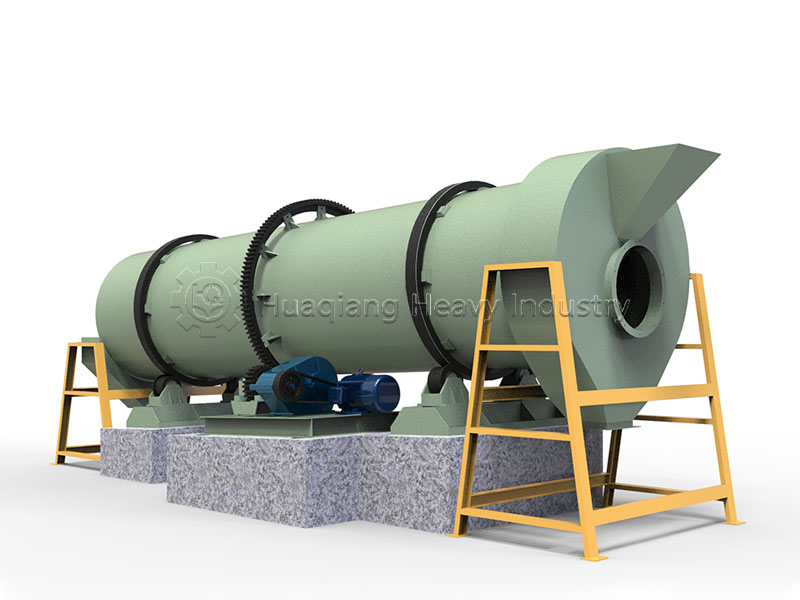
The coating machine is a core piece of equipment in the post-processing stage of fertilizer production lines, responsible for applying surface coatings to granular fertilizers. It plays a pivotal role in functionally upgrading the product by providing benefits such as anti-caking properties, slow- or controlled-release capabilities, and enhanced visual appeal. Utilizing a specialized spraying process that combines liquid raw materials with solid powders, the machine forms a protective film on the surface of the fertilizer granules. This film isolates the granules from the atmosphere, effectively preventing caking in compound fertilizers while improving surface luster; additionally, trace elements can be incorporated to boost fertilizer efficacy.
In practical fertilizer production, while granules that have undergone granulation, drying, and cooling possess their basic form, issues such as rough surfaces, susceptibility to moisture absorption and caking, and excessively rapid nutrient release significantly limit their commercial value and application performance. By creating a functional coating layer on the granule surface, the machine effectively blocks direct contact between the granules and external moisture, thereby delaying nutrient dissolution and release. Coated granules feature smooth surfaces, uniform color, and excellent flowability; this not only enhances the product's commercial value and market competitiveness but also imparts value-added characteristics such as slow-release, controlled-release, and long-lasting effects. The equipment features a specially designed internal structure that allows for flexible switching between various coating processes, meeting the production requirements of diverse fertilizer types. Characterized by high granule strength, corrosion resistance, low energy consumption, ease of operation and maintenance, and a long service life, the machine accommodates the combined use of dry powders and liquid coating agents, making it a key piece of equipment for the functional upgrading of products within fertilizer production lines.
The complete coating machine system comprises core components such as a screw conveyor, mixing tank, oil pump, and the main unit. The main unit consists of the following subsystems:
(I) Support Frame: The rotating body of the machine is supported by this frame, which bears significant loads. The support roller frame is fabricated from medium-carbon steel plate and channel steel, adhering to strict quality control and specialized manufacturing processes. The support rollers mounted on the frame are made of wear-resistant materials, significantly extending the equipment's service life. The frame utilizes an integrated casting design and features lifting hooks at the four corners to facilitate loading, unloading, and transport. The drive frame is constructed from high-quality welded channel steel, ensuring a robust and stable structure.
(II) Drive System: The main motor and gearbox mounted on the drive frame are of reliable quality. The motor drives the main shaft via a pulley, V-belt, and gearbox to operate the machine body. A nylon pin coupling connects the gearbox to the main shaft assembly to transmit power. The motor is equipped with a control cabinet and a starter cabinet to enable centralized control and system protection.
(III) Large Gear Ring: Fixed to the machine body, this ring meshes with the drive pinion to rotate the body. It utilizes high-tech wear-resistant materials to prolong the equipment's lifespan. The ring is made of wear-resistant alloy steel and undergoes integral annealing to relieve internal stress, ensuring gear precision and durability.
(IV) Riding Rings (Tires): Fixed to both sides of the machine body to support the entire assembly. Made of wear-resistant cast steel, they interface with the support rollers to ensure stable support and rotation of the drum.
(V) Machine Body (Drum): The core component of the coating machine, fabricated from medium-carbon steel plate under strict quality control and specific manufacturing standards. The drum can be fitted with a polypropylene liner or acid-resistant stainless steel lining, offering excellent corrosion resistance and anti-sticking properties. The interior features a screen mesh, a heating jacket, and a discharge port to facilitate cleaning and maintenance. Certain models are equipped with high-pressure air supply pipes and hot air ducts to assist the process. The inner wall of the drum is equipped with several arc-shaped scraper blades distributed evenly along the circumference; the curvature of these blades opposes the direction of the drum's rotation to enhance the material-tumbling effect.
(VI) Auxiliary systems: These include a screw conveyor (for material transport), a mixing tank (for preparing and stirring the coating agent), an oil pump (for supplying and conveying the liquid coating agent), spray piping and nozzles (for atomized application of the coating agent), as well as feed pipes, oil lines, and powder feed lines. The feed pipe, oil line, and powder feed line extend from the inlet side into the drum, with their extension lengths increasing sequentially; this arrangement ensures that fertilizer granules mix successively with the coating oil and the dispersing powder, achieving a uniform, multi-stage coating effect.
Coating machines are primarily utilized in the post-processing stage of fertilizer production, addressing the functional coating requirements of various granular fertilizers.
Compound and mixed fertilizer production: Suitable for applying anti-caking and slow-release coatings to granular compound and mixed fertilizers. These machines effectively prevent caking and enhance the surface luster of the granules.
Organic and bio-organic fertilizer production: Suitable for applying anti-caking coatings to organic fertilizer granules and coating them with biological agents. In bio-organic fertilizer production, drum coating machines are commonly used to encapsulate granules with slow-release materials, thereby preserving the viability of the microbial strains.
Slow- and controlled-release fertilizer production: Suitable for manufacturing polymer-coated slow/controlled-release fertilizers and sulfur-coated urea; these machines are essential for achieving precise nutrient release.
BB fertilizer (bulk blend) production: Serves as a common post-processing unit on BB fertilizer production lines, used to apply anti-caking coatings to the granules.
Specialty fertilizer production: Can be used to produce specialty fertilizers such as those coated with biological agents, pesticides, or colorants. They are also applicable to granule coating processes in industries such as food processing and pharmaceuticals.
The raw materials handled by the coating machine fall into two main categories: the materials to be coated and the coating materials themselves.
Materials to be coated: Various granular fertilizers, such as organic fertilizer granules, bio-organic fertilizer granules, compound fertilizer granules, blended fertilizer granules, BB fertilizer granules, urea granules, and magnetized fertilizer granules.
Coating materials (powders): Anti-caking powders, talc powder, bentonite, dispersing powders, diatomaceous earth, zeolite powder, etc.
Coating materials (liquids): Coating oils, liquid anti-caking agents, paraffin-based coating agents, polyvinyl alcohol-based coating agents, polymer emulsions, mineral oils, etc.
Coating materials (slow-release agents): Sulfur, resins, tung oil, polyurethane, magnesium slag, etc.
Coating materials (functional additives): Colorants, microbial agents, plant nutrient solutions, trace elements, polyglutamic acid, amino acids, etc.
The working principle of the coating machine is as follows: the main motor drives a belt and pulley system, transmitting power through a speed reducer to the drive shaft; a split gear mounted on the drive shaft meshes with a large ring gear fixed to the machine body, enabling counter-rotation. Material enters from the feed end, mixes with powder (or liquid) inside the rotating drum, and subsequently discharges from the outlet.
The specific operational process comprises the following stages:
Feeding and Distribution Stage: Granular fertilizer is conveyed via a screw conveyor into the elevated end of the rotary coating machine. As the drum rotates at a steady speed, curved scrapers on the inner wall continuously lift and scatter the granules, creating a uniform curtain of material within the drum.
Spraying and Coating Stage: Coating material is evenly applied to the surfaces of the tumbling granules using either a dry powder duster (for powder-based processes) or a liquid spray system (for liquid coating processes). Feed, oil, and powder pipes extend from the inlet side into the drum; their lengths are staggered so that fertilizer granules first mix with the coating oil and subsequently with the dispersed powder. The action of the scrapers causes the material to tumble and mix continuously, ensuring each granule is evenly coated.
Fluidization and Curing Stage: As the drum rotates, the fertilizer granules are thoroughly mixed with and coated by the coating agent while being transported toward the discharge end, resulting in a stable coating finish. Some models are equipped with high-pressure air lines and hot air ducts to assist with drying and curing.
Discharge Stage: Once coated, the granules exit through the discharge port. The finished coated granules are uniform, spherical, and aesthetically pleasing, ready to proceed directly to the packaging stage.
Uneven coating: Clean or replace clogged nozzles to ensure proper atomization. Inspect and replace worn lifting flights. Adjust the drum rotation speed to the optimal range (typically 6–15 rpm). Adjust the coating agent viscosity based on material properties. Stabilize the feed rate by installing a buffer hopper and a metering feeder at the inlet.
Granule agglomeration: Reduce the coating agent spray volume to an appropriate level. Increase the hot air temperature to accelerate coating layer curing. Keep the feed rate within design limits. Reduce the coating agent viscosity to an appropriate level.
Coating layer peeling: Install a dedusting device to remove surface dust from granules before coating. Select coating materials with good affinity for the substrate. Optimize curing temperature and time to ensure the coating layer cures fully.
Equipment vibration or abnormal noise: Stop the machine immediately for inspection. Tighten loose bolts. Inspect and replace damaged riding rings. Adjust gear mesh clearance. Replace damaged bearings.
Nozzle clogging: Promptly clean pipelines and nozzles after shutdown. Filter the coating agent to remove impurities before use. Regularly check for nozzle wear and replace severely worn nozzles promptly.
Drive belt slippage: Check if the sides of the drive belt's concave connectors are securely clamped; use shims or wedges to ensure a tight fit between the belt and the connectors.
Machine body misalignment: Inspect the wear level of the support rollers; refurbish or replace rollers as necessary and realign the drum position.
Call us directly, submit a sample or email us!