
Double Roller Press Granulator

double roller press granulator

Double Roller Press Granulator

The double-roller extrusion granulator is a powder-forming machine that utilizes a dry extrusion granulation process; it is primarily used for granulation in industries such as fertilizers, chemicals, pharmaceuticals, food processing, and dyes. The equipment directly transforms powdered raw materials into granules through double-roller extrusion, eliminating the need for binders or water.

Unlike traditional wet granulation methods, the double-roller extrusion granulator employs a purely physical, dry-forming process. Materials are compacted under mechanical pressure without the addition of wetting agents, thereby ensuring product purity. The bonding force between granules arises not from chemical adhesion, but from intermolecular forces such as van der Waals forces, adsorption, crystal bridging, and mechanical interlocking. In essence, the dry granulation principle relies on physical extrusion and the material's inherent self-bonding properties; by eliminating the need for water or binders, it bypasses the costly drying stage.

This equipment utilizes a drying-free, ambient-temperature process, which can reduce subsequent drying costs by 30% to 50%. The complete system features a compact, scientifically optimized layout and offers benefits such as energy efficiency, zero waste emissions, and stable, reliable operation. It requires low initial investment, yields quick results, and delivers strong economic returns.

Working Principle of the Double-Roller Press Granulator:

The working principle of the twin-roll extrusion granulator is based on dry extrusion granulation technology. Various dry powder materials are fed into the top of the equipment, where they undergo degassing and screw pre-compression before entering the twin-roll assembly. Under the immense compressive force exerted by the rolls, the material undergoes plastic deformation and is compressed into sheets. These sheets subsequently undergo crushing, granulating, and screening processes to yield the final granular product. The extrusion force can be adjusted via the hydraulic cylinder pressure to meet specific granulation requirements.
In terms of the drive mechanism, the process operates as follows: an electric motor drives a belt and pulley system, transmitting power through a gearbox to two output shafts; each output shaft then drives one of the two forming rolls—via a coupling—to rotate in counter-directions. Material is introduced through the feed hopper, compressed and formed between the twin rolls, and released; it is then conveyed by a chain system to a crushing chamber. Finished granules are separated by screening, while undersized material (fines) is recycled and mixed with fresh raw material for re-granulation. Continuous motor rotation and material feeding enable mass production.
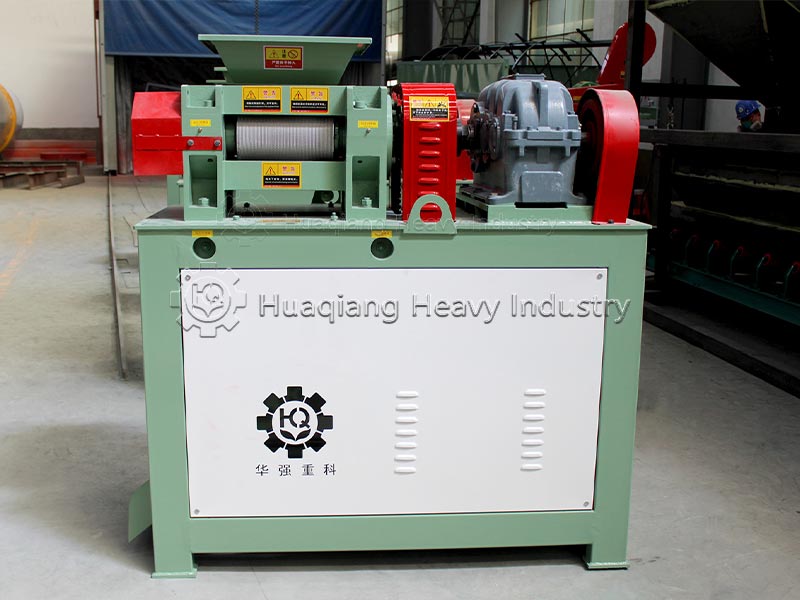
Structural Composition of the Double-Roller Press Granulator:

The twin-roll extrusion granulator consists of four main components:
1. Frame Assembly
All functional components of the machine are mounted on the frame, which is constructed by welding medium-carbon steel plates and channel steel.
2. Drive and Transmission Assembly
This assembly comprises the electric motor, pulleys, V-belts, speed reducer, chains, sprockets, and couplings. The motor drives the pulleys and V-belts, transmitting power through the speed reducer to operate the granulator head. A nylon pin coupling connects the reducer to the granulator head to transmit drive power. In the DZJ-I model, the two rolls interact via a pair of meshing gears; in the DZJ-II model, the two rolls are driven directly by two output shafts from a specialized speed reducer.
3. Granulator Head Assembly (Extrusion System)
This is the core component of the equipment. Power is transmitted from the drive pulley through a pin coupling to the drive roll shaft, with synchronous rotation of the twin rolls ensured by a pair of open gears. Key parts include the bearing housings, a pair of high-pressure roll shells (pressure rolls), and two shafts. The specifications (diameter and length) of the pressure rolls directly determine the equipment's production capacity. The roll surfaces typically feature shaped cavities (with adjustable extrusion apertures, usually 8–16 mm) to form the granules.
4. Crushing and Separation Assembly (Crushing Chamber)
After passing through the extrusion rolls, the material flows into the crushing chamber below. Here, the rotation of a dual-shaft "spiked roller" (or "wolf-tooth" roller) separates the formed granules from the material to be recycled. This section consists of the crushing roll bearing housings, crushing rolls, and screening mesh.
Additionally, the core of the equipment is the twin-roll extrusion unit, primarily consisting of a pair of counter-rotating pressure rolls. The machine is typically equipped with a forced feeding system—such as a conical screw feeder—to ensure that raw materials enter the gap between the rolls uniformly and continuously.

Technical Characteristics and Core Advantages of the Double-Roller Press Granulation Technology:

1. Purely physical dry forming; no binders required
Materials are mechanically compressed into shape without the addition of wetting agents, ensuring product purity. This avoids common issues associated with wet granulation, such as solvent residues, material degradation, and deformation during drying.
2. Drying-free, room-temperature process; significant energy savings
Extrusion granulation takes place at ambient temperature, eliminating the need for fuel- or gas-based drying systems. Direct granulation of dry powder removes the need for subsequent drying steps, facilitating the integration and retrofitting of existing production lines.
3. High granule strength and significantly increased bulk density
The process yields granules with high strength and achieves a more substantial increase in bulk density compared to other granulation methods. Twin-roll extrusion involves compressing material into large slabs before crushing them into granules, resulting in high capacity, superior granule strength, and low energy consumption.
4. High operational flexibility and broad applicability
Extrusion pressure can be adjusted via hydraulic force, offering great operational flexibility and suitability for a wide range of applications.
5. Streamlined process and high output
The process is streamlined, energy-efficient, and capable of high output. The entire production cycle generates no waste gas, wastewater, or solid waste, making it energy-saving and environmentally friendly.
6. Suitable for heat-sensitive materials
The purely physical dry forming process is particularly well-suited for handling materials that are heat-sensitive, hygroscopic, or prone to melting. Some equipment models feature a water-cooled, constant-temperature extrusion design to effectively control processing temperatures.
 

Equipment issues and their solutions:

I. Molding Quality Issues (Failure to form granules/briquettes, insufficient strength)
1. Failure to form granules or briquettes (material forms cakes/slabs)
Abnormal material supply: Feeder blockage, obstructed conveying pipes, or large impurities in the material preventing smooth entry into the granulator.
Abnormal roll gap: Gap is too wide, resulting in insufficient extrusion pressure to form granules; or the gap is uneven (narrow at the ends, wide in the middle), causing uneven extrusion.
Pocket issues: Pockets on the roll surface have become shallow or deformed due to long-term wear, preventing effective material filling; axial or circumferential misalignment of pockets.
Unsuitable material properties: Moisture content too high (material becomes muddy clumps) or too low (lacks adhesiveness, hard to mold); adhesiveness is insufficient or excessive.
Solutions:
Regularly inspect the feeding system and clear debris from the feeder and conveying pipes; install screening equipment upstream to remove large particles and impurities.
Precisely adjust the roll gap based on material properties, maintaining it between 0.3–1 mm; if the gap is uneven (narrow ends, wide middle), grind down the ends to ensure uniformity.
Correct pocket misalignment by tightening the bolts behind the pockets; if the fit between the roll shell and the shaft is loose, replace the roll shell or shaft.
Pre-treat with drying equipment if moisture is too high; add appropriate binders (e.g., bentonite, starch) if adhesiveness is insufficient.
2. Insufficient granule strength or brittleness
Pressure and gap issues: Insufficient extrusion pressure prevents proper bonding between material particles, leaving excessive voids; roll gap is too wide.
Roll surface wear: Severe wear reduces surface roughness, impairing compaction effectiveness.
Improper material formulation: Insufficient binder content or incorrect proportions.
Solutions:
Control material moisture within an optimal range (typically 5%–10%).
Reduce the roll gap and increase extrusion pressure. However, note that excessive pressure can lead to over-densification and embrittlement, making the granules prone to breakage. Periodically repair or replace worn roller surfaces (e.g., via hardfacing or spraying with wear-resistant materials).
Optimize the formulation by adding an appropriate amount of binder to improve granule toughness.
II. Clogging and Jamming Issues
1. Material Clogging (at the feed inlet, between rollers, or at the discharge outlet)
Excessive moisture or stickiness: Material adheres to the inner walls of the feed inlet, gradually accumulating to form a blockage.
Excessive feed rate: Exceeds the equipment's processing capacity, causing material to pile up between the rollers or at the discharge outlet.
Failure to clean the equipment regularly: Residual material cakes and obstructs the entry of new material.
Debris in the discharge channel or improper adjustment of the discharge baffle.
Solutions (ensure the machine is stopped and power is disconnected before proceeding):
Feed inlet blockage: Use tools to clear adhered material from the inner walls; break up caked material before feeding it in.
Blockage between rollers: Clear residual material, adjust the gap between the pressure rollers, and run the machine without load to verify clear operation.
Discharge outlet blockage: Clear debris and adjust the angle of the discharge baffle.
Strictly control material moisture content; for overly sticky materials, add an appropriate amount of dry material to adjust humidity.
2. Roller Jamming or Difficult Rotation
Hard impurities (stones, metal fragments) mixed into the material.
Excessive roller surface temperature causing material adhesion.
Damaged bearings or insufficient lubrication.
Drive system failure (belt slippage, motor overload).
Solutions:
Stop the machine to inspect the area between the rollers and the feed inlet; remove hard foreign objects.
Periodically replace bearing grease and ensure the cooling system is functioning correctly.
Adjust belt tension; replace worn gears or couplings.
III. Component Wear and Corrosion Issues
1. Pressure Roller Wear (Most Common Issue)
Prolonged contact with material and exposure to high pressure make pressure rollers highly susceptible to wear, scratches, surface irregularities, and even cracking. Causes: Hard objects (sand, stones, metal, etc.) mixed into the material; improper moisture content increasing extrusion resistance; lack of regular lubrication and maintenance; insufficient wear resistance of the roller material.
Remedies: For minor wear, sand the roller surface with fine sandpaper; for moderate wear, repair via build-up welding; for severe wear (cracks or significant deformation), replace the roller entirely.
Prevention: Strictly screen materials to remove hard objects before operation; strictly control moisture content (recommended 18%–25% for organic fertilizer, 10%–15% for compound fertilizer); perform regular lubrication and maintenance; select high-quality, wear-resistant rollers.
2. Roller surface corrosion
Presence of corrosive components in the material (e.g., acidic fertilizers); metal fatigue caused by long-term, high-load operation.
Solutions: Use stainless steel or chrome-plated rollers for corrosive materials; regularly apply wear-resistant coatings (e.g., tungsten carbide); avoid prolonged idling.
IV. Abnormal operation issues
1. Excessive equipment vibration or noise
Loose anchor bolts or uneven foundation.
Damaged roller bearings or poor gear meshing.
Loose or worn transmission components (couplings).
Solutions: Check and tighten anchor bolts, bearing housings, and other connections; promptly replace damaged bearings, gears, or couplings; recalibrate roller installation position to ensure concentricity.
2. Motor overload or frequent tripping
Excessive feed rate exceeding equipment capacity.
Roller seizure or increased resistance in the transmission system.
Unstable voltage or undersized motor selection.
Solutions: Reduce feed rate to avoid instantaneous overload; ensure stable voltage (install a voltage stabilizer if necessary); replace with a higher-power motor if long-term overload operation is required.
3. Reduced output
Poor material flow (hopper blockage, screw wear).
Decreased roller rotation speed.
Excessive extrusion gap. Solution: Clean the hopper and conveying pipelines; inspect and replace worn screws; check the motor and drive system to ensure normal roller rotation speed; adjust the roller gap to the appropriate range.
V. Roller Adhesion Issues with New Equipment
New machines are prone to material sticking to the rollers.
Causes: Excessive adhesive ratio; feeding material for production without performing a mold-release run; rough surface on the new roller pockets.
Solution: Do not attempt to grind the surface forcefully using an angle grinder and wire brush; instead, consult professionals for a proper grinding plan to avoid damaging the roller surface or necessitating part replacement. After assembly, the new machine should undergo a mold-release test run and achieve complete release before entering formal production.
VI. Preventive Maintenance Recommendations
Daily Inspections: Check roller surfaces, bearings, and drive components daily for signs of wear.
Lubrication and Maintenance: Rolling bearings generally require regreasing every 200–300 hours of operation; gear oil in the reducer should be changed every four months.
Equipment Cleaning: Clear away residual material after every shutdown to prevent caking.
Monitoring Operating Parameters: Detect anomalies promptly by monitoring parameters such as temperature, pressure, and current. Excessive bearing temperature may indicate insufficient lubrication; a sudden spike in current could signal mechanical jamming or overload.
Operator Training: Ensure operators are familiar with equipment parameter adjustments and emergency response procedures.

Roller Extrusion Granulator Models and Specifications

Fertilizer Granules Compaction Machine
ModelDZJ-I 1.0DZJ-I 2.0DZJ-I 3.0DZJ-I 3.0
Capacity (t/h)1-1.51.5-2.52-33-4
Power (Kw)1118.52245
Roller Dimension(mm)ø150x220ø150x300ø186x300ø300x300
Feed Material Size(mm)<=0.5<=0.5<=0.5<=0.5
Output Granules Size(mm)ø2.5-ø10ø2.5-ø10ø2.5-ø10ø2.5-ø10
Gearbox ModelZLY-160ZLY-160ZLY-180ZLY-224
Rotation Speed (r/min)60606060

All Services

Let's Start a Project

Call us directly, submit a sample or email us!

Office Address: NO.313, Wanshan Road, Xingyang City, Zhengzhou City, Henan Province, China
Contact With Us Call us: +86-18703630069