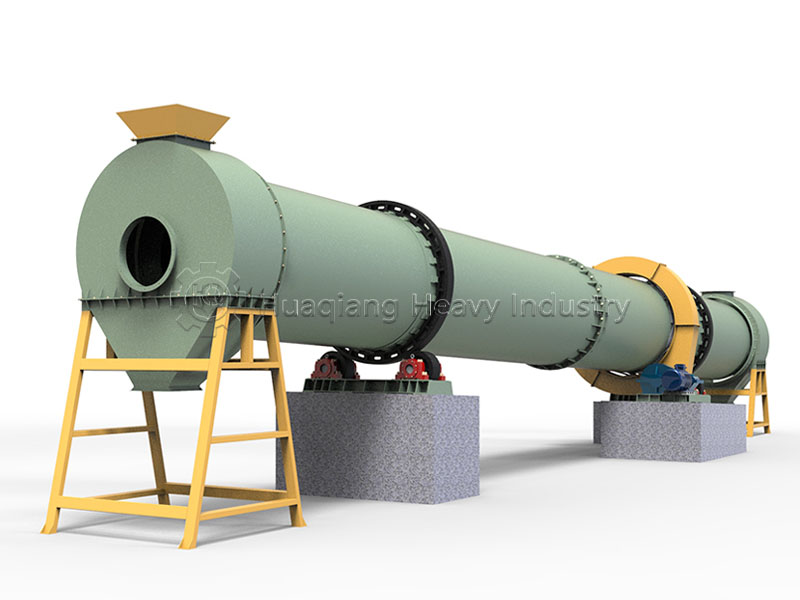
The rotary fertilizer dryer is one of the most heavily loaded and continuously operating pieces of equipment in a fertilizer production line, functioning under conditions of high temperature, heavy load, and high dust levels. It involves the coordinated operation of multiple systems—including gear drives, support rollers, and hot-air systems—amidst high internal temperatures and significant external loads; consequently, negligence in any aspect can lead to equipment failure or even safety accidents. Given its pivotal role in the production line, any downtime can bring the entire operation to a standstill. Mastering correct operating and maintenance procedures, as well as troubleshooting techniques, is essential to ensuring the dryer's long-term, efficient, and stable performance.
The operation and maintenance of the rotary fertilizer dryer encompass several specialized fields: mechanical transmission (gear meshing, bearing lubrication, support roller adjustment), thermal control (temperature regulation, airflow control, system negative pressure), material handling (feed uniformity, discharge flow), and environmental protection/dust removal (exhaust gas treatment, dust control). Establishing a scientific and standardized operation and maintenance system is fundamental to extending the equipment's service life, reducing failure rates, and ensuring production continuity.
From the perspective of operation and maintenance, the rotary fertilizer dryer can be categorized into the following modules:
(I) Drum and Support Module: Includes the rotary drum, front and rear riding rings (tires), front and rear support rollers, thrust rollers, etc. The drum is the largest component of the equipment and is subjected to the combined effects of hot air and the material being processed. The riding rings and support rollers are critical components that support the drum and ensure its smooth rotation; as they endure long-term cyclic loading, their wear status requires regular inspection. The contact area between the support rollers and the riding rings should be at least 70%.
(II) Drive Module: Includes the electric motor, gearbox, pinion gear, girth gear, drive shaft, etc. The girth gear and pinion gear utilize an open-gear drive arrangement, and their meshing condition directly affects the operational stability of the equipment. Gear wear or poor meshing can result in periodic impact noises and vibrations.
(III) Material Lifting Module: Includes various types of lifting flights (lifters) installed on the inner wall of the drum. These lifting flights are core working components that act directly on the material; wear and material buildup (scaling) are the most common issues associated with them.
(IV) Sealing Module: Includes sealing rings at both the feed and discharge ends. Poor sealing leads to cold air infiltration and hot air leakage, thereby reducing thermal efficiency and increasing dust emissions.
(V) Hot Air and Dust Removal Module: Includes the hot air duct, induced draft fan, cyclone dust collector, baghouse dust collector, etc.
Rotary fertilizer dryers are widely used in the drying workshops of organic fertilizer plants, the drying sections of compound fertilizer facilities, the product drying stages of chemical enterprises, sludge drying centers in the environmental protection industry, and drying production lines at agricultural waste processing plants.
Materials that can be processed by the rotary fertilizer dryer include organic fertilizer granules, compound fertilizer granules, blended fertilizer granules, phosphate and ammonium sulfate granules, livestock and poultry manure granules, straw pellets, distillers' grains, medicinal residues, fruit pomace, sludge, ammonium sulfate, ammonium nitrate, urea, oxalic acid, compound fertilizers, fluorite powder, quartz sand, graphite, bentonite, zinc slag, coal slime, and limestone.
The working mechanism of the rotary fertilizer dryer relies on the synergy of three processes: the rotation and scattering of material within the drum, convective heat exchange with hot air, and axial movement driven by gravity. As the drum rotates at a steady speed, lifting flights scoop up and scatter the material to form a "material curtain"; hot air passes through this curtain to facilitate heat exchange, while gravity causes the material to move slowly toward the discharge end, transforming it from wet granules into dry ones.
Daily Inspections: Check the drive belt tension and gear lubrication status during every shift. Observe the stability of the cylinder's oscillation on the support rollers. Inspect the sealing rings for integrity. Monitor the cylinder surface to ensure uniform temperature distribution.
Support Roller and Tire Maintenance: Check support roller base bolts weekly for looseness. Inspect the tire for cracks. Periodically adjust the tilt of the support rollers to maintain the cylinder's balance between the thrust rollers. The contact area between the support rollers and the tire should be at least 70%.
Sealing Device Maintenance: Periodically inspect sealing rings for wear; replace them promptly if wear or aging is detected.
Lifter Plate Maintenance: Periodically inspect lifter plates for wear and material buildup; clean or replace them as necessary.
Lubrication Management: Check the grease in support roller bearings and drive bearings during every shift, and replenish with high-temperature grease weekly. Change the oil in the gearbox 30 days after initial operation, and subsequently clean and change the oil every six months. Ensure gears remain well-lubricated to minimize wear.
Insufficient drying efficiency: Replace damaged heating tubes; clean dust accumulation from fan impellers; modify lifters to a composite structure; maintain feed moisture content between 25% and 35%.
Vibration and noise: Stop the machine immediately for inspection; tighten loose bolts; inspect and replace damaged riding rings; adjust gear mesh clearance.
Cylinder axial drift: Adjust the inclination of the support rollers to balance the cylinder between the thrust rollers and correct the cylinder's axial position.
Air leakage at seals: Promptly replace worn or aged sealing rings; adjust seal clearance.
Scaling on lifters: Regularly clean scale deposits from the inner cylinder wall; control feed moisture content; utilize anti-stick lifter designs.
Call us directly, submit a sample or email us!