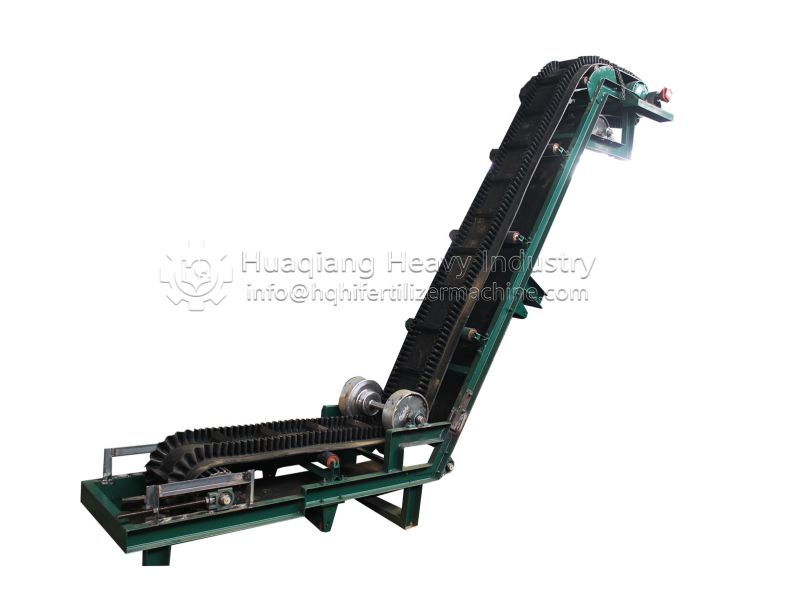
Large-angle belt conveyors are special conveying equipment that uses corrugated sidewalls and cross diaphragms to achieve large-angle material conveying. They are a new type of continuous conveying equipment with features such as large conveying capacity (1.5-2 times higher than other conveyors), strong versatility (basic components are the same as general-purpose belt conveyors), and wide applicability.
The value of large-angle belt conveyors in industrial production lies not only in the improved efficiency of material conveying but also in their role in ensuring the continuous and automated operation of production lines. This equipment can directly replace the combined arrangement of "ordinary conveyor + bucket elevator," significantly saving floor space and investment. With its outstanding advantages of strong conveying capacity, stable operation, and wide adaptability, large-angle belt conveyors have become an indispensable large-angle material conveying equipment in modern industrial production.
The biggest structural difference between a large-angle belt conveyor and a general-purpose belt conveyor lies in its corrugated sidewall conveyor belt.
(I) Corrugated Sidewall Conveyor Belt: This belt provides traction and load-bearing capacity. The corrugated sidewalls, crossbars, and base belt form a "cassette"-shaped container for conveying materials.
(II) Drive Unit: Y-series motor, ZJ-type shaft-mounted reducer, wedge-type backstop.
(III) Drive Drum and Idling Drum.
(IV) Idler Rollers, Tensioning Device, Scraper, and Safety Devices.
Large-angle belt conveyors are widely used in various industries such as coal, chemical, building materials, metallurgy, power, light industry, grain, ports, and shipbuilding. Multiple units can be combined into a conveying system to achieve continuous material transport over long distances, across large spans, and at large angles, according to the conveying process requirements.
Large-angle belt conveyors are suitable for conveying bulk materials such as crushed stone, limestone, coal, sand, clay, sintered sand powder, sawdust, and grain. Operating ambient temperature: -19℃ to +40℃.
The working principle of a large-angle belt conveyor is basically the same as that of a general belt conveyor. Its structure consists of vertical, freely stretchable rubber corrugated "skirts" glued to both sides of a flat rubber conveyor belt. Between the skirts, there are cross-sections with a certain strength and elasticity, forming a box-shaped bucket, which allows materials to be continuously conveyed in the bucket.
(I) Pre-start Preparation: Check all fastening bolts for looseness. Check the conveyor belt for damage. Confirm the backstop is in good working order.
(II) Start-up Sequence: Start the discharge equipment first, then start the conveyor. Start under no-load conditions.
(III) Operation Monitoring: Ensure even feeding and avoid overloading. Observe the conveyor belt for smooth operation.
(IV) Shutdown Procedure: Stop feeding material first, and then stop the machine only after all material has been discharged.
Routine Maintenance: Clean residual materials and dust from the equipment after each shift. Inspect the conveyor belt for damage.
Periodic Maintenance: Regularly tighten bolts and nuts. Regularly check the conveyor belt direction.
Lubrication Management: Add lubricating oil promptly to ensure proper lubrication of the bearings.
The main users of large-angle belt conveyors include: material handling managers in mining, coal, and metallurgical enterprises; equipment managers in building materials and chemical industries; bulk material handling managers in power and port industries; warehouse managers in grain processing and feed production enterprises; production managers in fertilizer production enterprises; equipment selection personnel in engineering design and general contracting units; and various production enterprises that need to achieve large-angle material lifting and effective utilization of vertical space.
Call us directly, submit a sample or email us!