

Call us
+86-18703630069
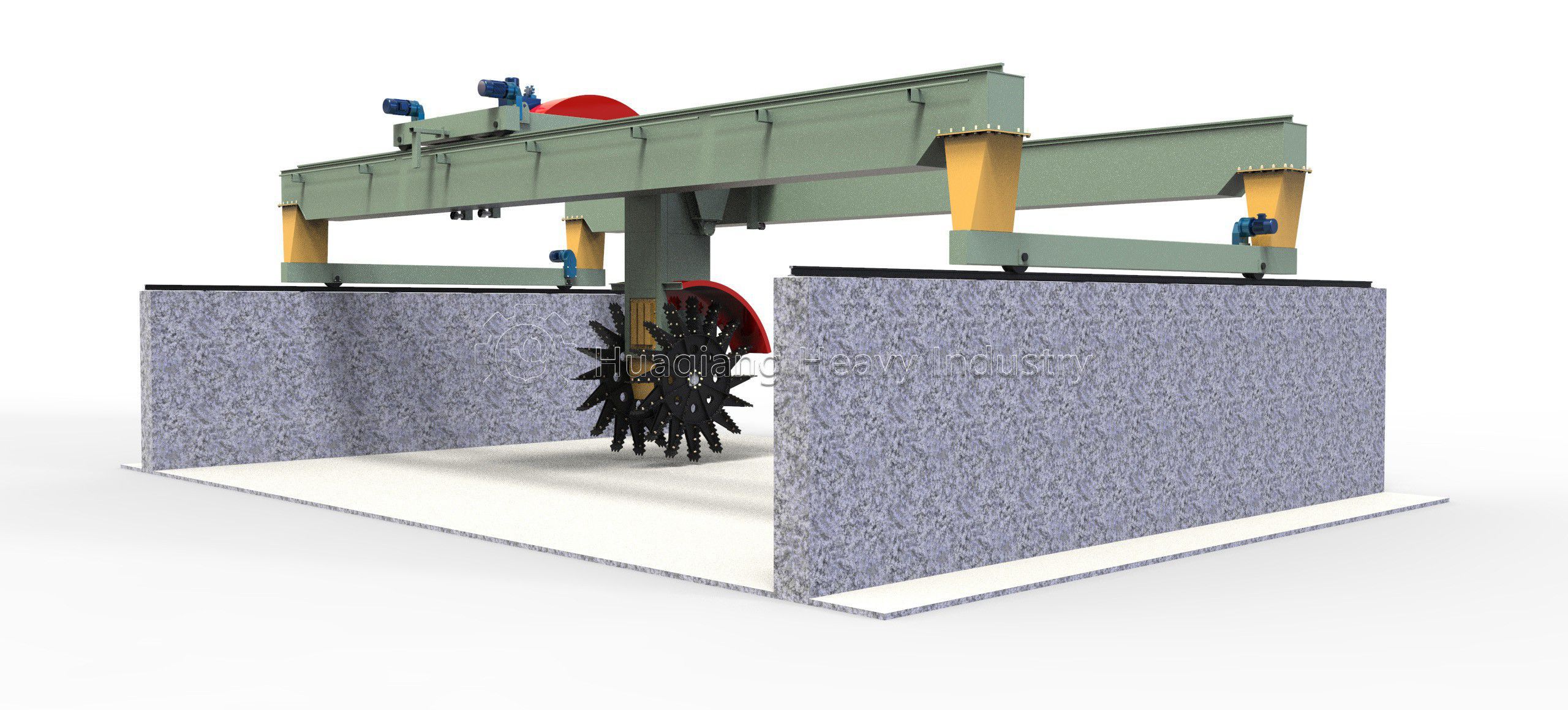
Large Wheel Compost Turner
Large wheel compost turners are core fermentation equipment in the fields of organic fertilizer production, municipal sludge treatment, and agricultural waste resource utilization. Utilizing a mechanical rotating-wheel mixing structure combined with an aerobic fermentation process, the equipment performs material turning, mixing, oxygenation, and displacement, thereby accelerating the decomposition and fermentation of organic materials. With key advantages such as deep-pile processing capabilities, high throughput, uniform decomposition, and intelligent, hassle-free operation, it effectively resolves challenges faced by large organic fertilizer plants—specifically regarding deep-layer fermentation, insufficient production capacity, and uneven decomposition. It serves as high-end supporting equipment for the large-scale, harmless treatment of manure and waste, as well as for the standardized, mass production of organic fertilizer.
Hardware Configuration and Component Functions
The hardware components of the large-wheel compost turner primarily include:
(I) Rotor assembly: The core working component of the equipment, comprising the rotor body and the turning blades mounted on it; the rotor is manufactured from high-strength, wear-resistant steel.
(II) Frame assembly: The load-bearing structure of the equipment, fabricated from high-strength steel via welding and processed using high-power plasma cutting.
(III) Drive assembly: Includes the motor, gearbox, and chain drive mechanism, responsible for driving the rotation of the rotor.
(IV) Travel assembly: Includes the travel mechanism and shifting system, responsible for moving the equipment across the fermentation site.
(V) Hydraulic assembly: Includes the hydraulic lifting system, responsible for adjusting the height of the rotor.
(VI) Control assembly: Includes a fully automated electrical control system, responsible for the intelligent operation of the equipment.

Comparative advantages over other windrow turning equipment
Compared to other composting equipment, the large-wheeled compost turner offers significant advantages:
Compared to trough-type turners: The large-wheeled turner saves considerable space while offering a wider turning range, greater depth, more uniform mixing, and higher efficiency. It achieves turning depths of 1.5–3 meters—far exceeding traditional trough-type models—and the turning width can be customized to specific requirements.
Compared to small crawler-type turners: The large-wheeled turner boasts a higher processing capacity; a single unit can meet large-scale fermentation needs without requiring multiple machines to work in tandem. It offers greater turning depth, effectively processing deep compost piles, and demonstrates superior adaptability to various site conditions.
Summary of core advantages: The large-wheeled compost turner excels in key areas such as turning depth (1.5–3 meters), turning span (up to 30 meters), mixing uniformity (no dead zones), energy efficiency (energy-saving, high-efficiency drive system), and automation (fully automated control).
Application Landscape and Audience Distribution
Large wheel compost turners have a wide range of applications and target audiences: Large organic fertilizer production enterprises: using livestock and poultry manure, straw, etc. to produce commercial organic fertilizer.
Large-scale livestock farms: Processing waste such as pig, cattle, and chicken manure.
Municipal sludge treatment plants: Processing urban sludge via aerobic composting.
Agricultural waste treatment centers: Processing agricultural by-products like crop stalks and rice husks.
Industrial organic waste treatment enterprises: Processing materials such as sugar mill filter mud, distillery grains, and pharmaceutical residues.
Compound fertilizer plants, horticultural nurseries, and button mushroom farms: Used for fermentation, decomposition, and moisture reduction.

Material Range and Processing Capacity
The large-scale wheeled compost turner is capable of processing a wide range of organic waste materials. In terms of capacity, the equipment meets the large-scale production requirements of fermentation projects handling tens of thousands of tons. Featuring a design that utilizes multiple coordinated rotating wheels, it offers an operating width of 5 to 10 meters. The machine can process tens of thousands of cubic meters of compost material daily and achieves a turning depth of up to 3 meters.
Operational Mechanism and Fermentation Principles
The operating mechanism of the large-wheel compost turner is based on a synergistic "mechanical agitation, forced aeration, and directional displacement" approach. As the high-speed rotating wheels penetrate the material pile, they perform three core functions: agitation and pulverization (thoroughly breaking up compacted material), aeration and oxygenation (ensuring full contact between the material and air), and directional displacement (gradually moving the material from the feed end to the discharge end). The entire process constitutes an automated assembly-line operation covering feeding, turning, fermentation, and discharge.
Coordination between the fermentation process and the production line
Large-scale wheeled compost turners play an indispensable role in aerobic fermentation processes. The front section of the system can be equipped with proportioning and mixing units to blend raw materials with additives before feeding the mixture into the fermentation tank, where the turner operates by moving back and forth repeatedly. Downstream equipment—such as units for crushing, granulation, drying, cooling, screening, and packaging—can be integrated into the rear section of the line. The turning and mixing action ensures thorough contact between material aggregates and air, allowing various beneficial microorganisms to thrive within their optimal temperature ranges.
Fermentation Quality Control and Performance Assurance
Large-wheel compost turners play a pivotal role in controlling fermentation quality. Temperature control: Turning operations effectively regulate the temperature of the compost pile, establishing a beneficial cycle of high-temperature exchange and maintaining temperatures across all zones within the optimal range for decomposition. Oxygen supply: Turning ensures thorough contact between the material and the air, rapidly replenishing oxygen within the pile. Uniformity: Symmetrical turning by the wheels eliminates dead zones, significantly enhancing the consistency of the turning process. Cycle management: The fermentation cycle is controllable. Hygiene and safety: Pathogen inactivation rates meet high-standard requirements.
With their comprehensive advantages—including deep-reach capability, high processing capacity, uniform decomposition, and intelligent, hassle-free operation—large-wheel compost turners have become premium equipment for the large-scale, harmless treatment of manure and waste, as well as for the standardized, mass production of organic fertilizer.
Models and Specifications of Large-Wheel Compost Turners
| Large Wheel Compost Turning Machine | ||||
| Model | Main Motor | Small Car Moving Motor | Big Car Moving Motor | Hydraulic Pump Motor |
| LP-10m | 55KW | 1.5KWX4 | 1.5KWX2(4) | 4KW |
| LP-12m | ||||
| LP-15m | ||||
| LP-20m | ||||