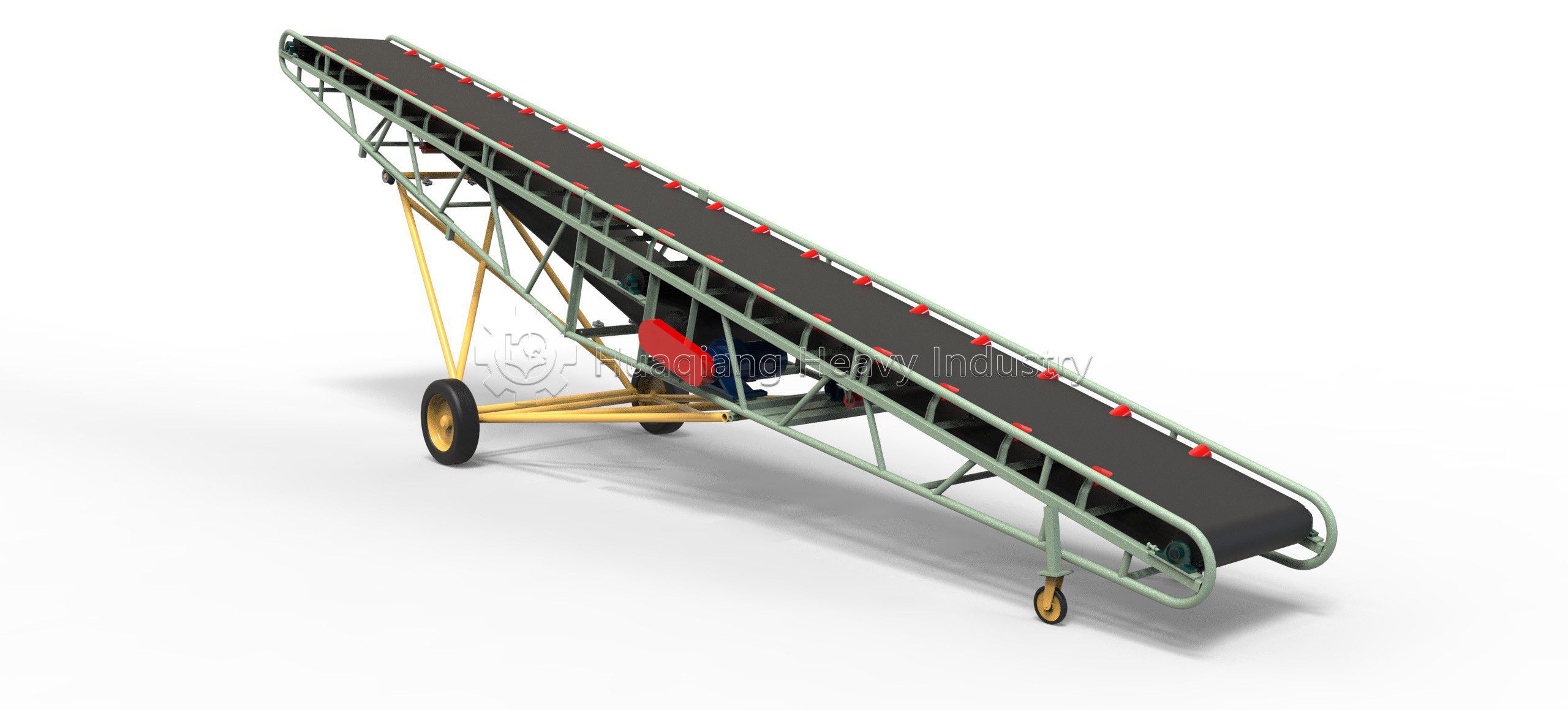
The mobile belt conveyor is a piece of continuous conveying and loading/unloading equipment characterized by high efficiency, safe and reliable operation, and excellent mobility. Lightweight and aesthetically designed, it is equipped with wheels (either pneumatic tires or steel wheels) at the base, allowing for flexible movement across the site without the need for a permanent foundation. The conveyor length can be customized between 5 and 20 meters, and the inclination angle is adjustable. Thanks to its flexibility, convenience, and ability to boost efficiency and stabilize output, the mobile belt conveyor is widely used across various sectors, including organic fertilizer production, grain transfer, construction site material transport, and the handling of chemical raw materials.
The mobile belt conveyor consists of a main frame (lightweight and flexible steel-pipe structure), traveling wheels (pneumatic tires or steel wheels), swivel wheels, a lifting mechanism (electric or manual), a conveyor belt, idlers, a pulley assembly (drive pulley and bend pulley), a tensioning device, and an electrical control system.
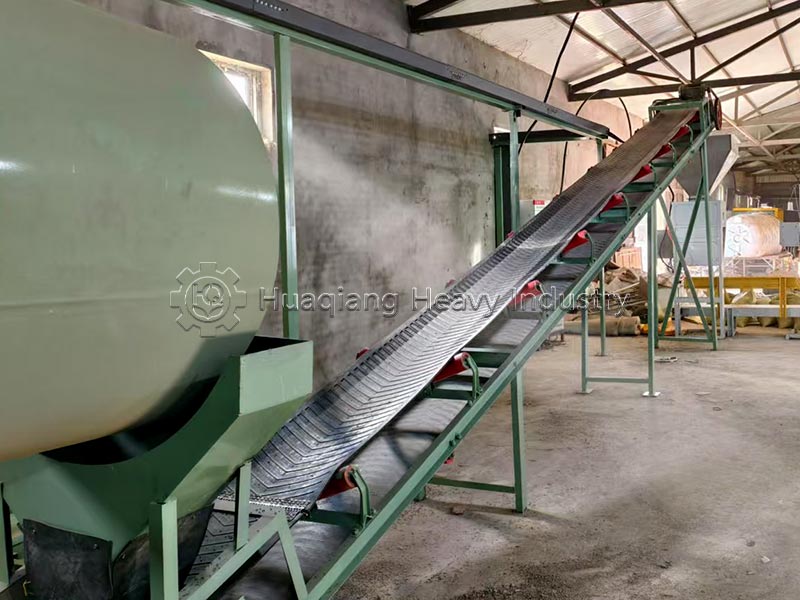
Mobile belt conveyors are widely used in short-distance transport scenarios requiring frequent relocation of operations. Specific applications include: cargo loading and unloading at ports, terminals, and stations; transport of coal and ore at coal yards and mines; transfer of sand and gravel at construction sites and aggregate yards; material handling in warehouses and factories; transport of raw materials and finished products at chemical and organic fertilizer plants; transport of grain and feed at grain depots and feed processing plants; and transport of fertilizer and feed on farms and at livestock facilities.
This equipment is suitable for conveying low-abrasiveness materials—in powder, granular, or small-lump form—with a bulk density of less than 1.67 t/m³, as well as bagged materials. Bulk materials that can be conveyed include coal, crushed stone, sand, cement, chemical fertilizers, grain, cereals, and ore. Conveyable unitized items consist of bagged materials weighing up to 100 kg per unit. The temperature of the conveyed material must be below 60°C.
The working principle of the mobile belt conveyor is as follows: a conveyor belt, supported by upper and lower idlers, loops around the head and tail pulleys to form a closed circuit. The drive unit transmits power through friction between the drive pulley and the conveyor belt, driving the belt in continuous operation. Material is loaded onto the belt at the feed end and transported to the discharge end for unloading. The equipment is capable of conveying materials horizontally, as well as along upward or downward inclines.
(I) Pre-start inspection: Thoroughly inspect all components of the equipment to ensure they are in good condition. Check for belt misalignment, ensure joints are secure, verify that idlers rotate freely, and check for any loose fastening bolts.
(II) No-load startup and operation: Start the equipment without a load and wait for normal operation before feeding material. Feed material evenly during operation to avoid overloading, and closely monitor the equipment's operating status.
(III) Shutdown procedure: Stop feeding material first; cut off the power supply only after all material has been fully discharged from the belt. Riding on the conveyor is strictly prohibited.
(I) Daily maintenance: Clean up residual material and dust after each shift. Inspect the conveyor belt for damage. Check the lubrication status of the roller bearings.
(II) Periodic maintenance: Tighten bolts and nuts monthly. Regularly check the conveyor belt alignment. Periodically inspect idlers and other components. Calibrate the pressure valves of the hydraulic lifting system quarterly.
(III) Lubrication management: Replenish lubricating oil in a timely manner to ensure proper bearing lubrication.
Conveyor belt slippage: Adjust the tensioning device to increase initial tension; apply powdered rosin to the pulley to increase friction.
Conveyor belt mistracking: Adjust the idler sets; adjust the tensioning device; align the pulley centers.
Abnormal noise: Replace eccentric idlers; replace worn bearings and gears.
Belt breakage: Reduce tension; replace with a new belt promptly; improve the quality of splice repairs.
Call us directly, submit a sample or email us!