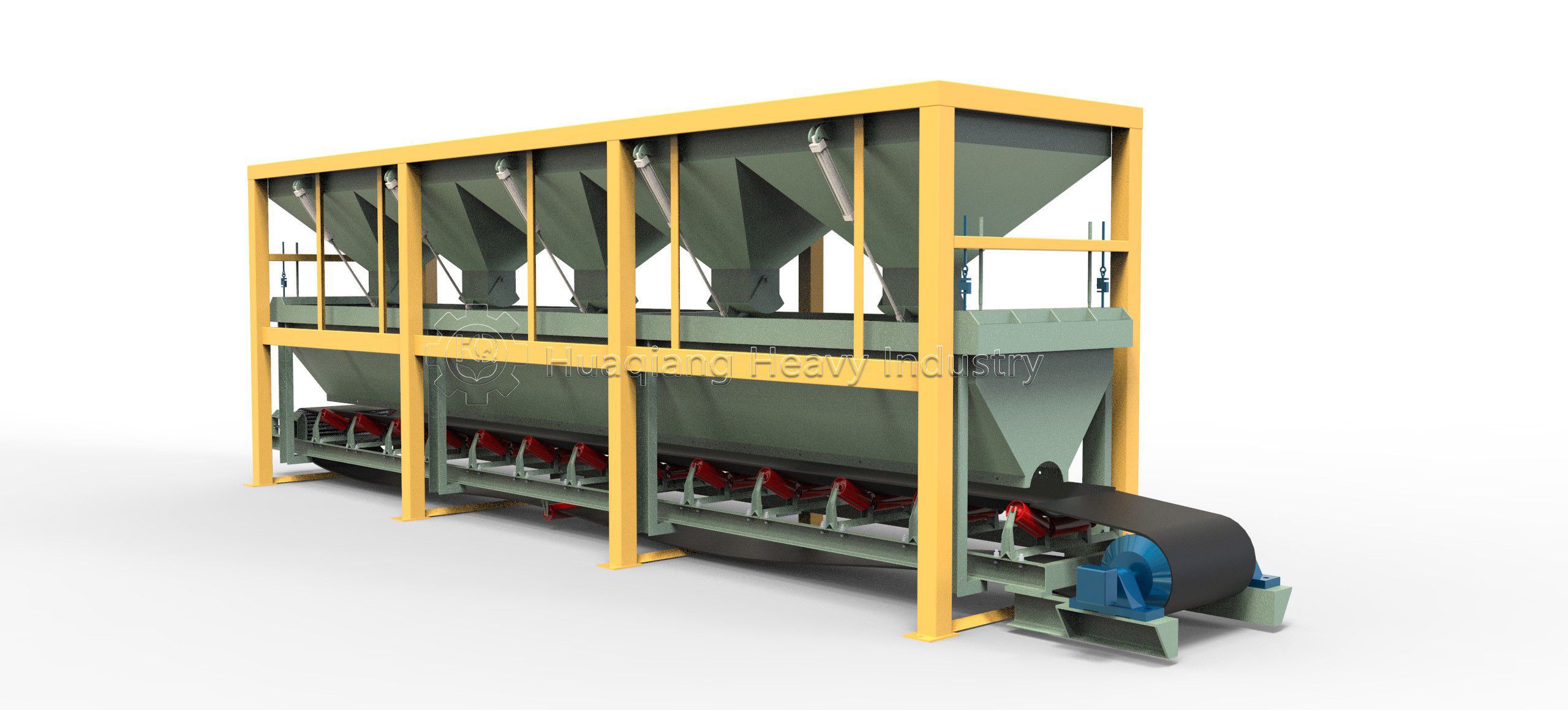
The multi-silo static automatic batching system can handle a wide variety of raw materials. Organic materials include: livestock and poultry manure, crop straw, humic acid, peat moss, etc. Fertilizer materials include: urea, potassium chloride, potassium sulfate, monoammonium phosphate, diammonium phosphate, etc. Additives include: trace elements, biological agents, etc. The system can be adapted to raw materials with different moisture contents and particle sizes by customizing the silo capacity and adjusting the feeding mechanism.
Working principle of the equipment
The multi-silo single-weighing static automatic batching system operates on the principle of coordinated operation of sensors, PLC controllers, and actuators. According to the set formula, the system sequentially controls the feeding devices of each silo to add material to the weighing hopper. Weighing sensors monitor weight changes in real time, stopping feeding when the set value is reached. All materials are discharged uniformly after batching.
Equipment operation method
(I) Pre-start Preparation: Check that each hopper has sufficient raw materials. Check that the weighing sensors and junction boxes are functioning properly. Check that the feeding device is operating normally.
(II) Formula Setting and Startup: Retrieve or input the formula through the human-machine interface. Start the automatic batching program.
(III) Operation Monitoring: Monitor the weighing data displayed on the instruments or host computer in real time. Observe the operating status of each piece of equipment.
(IV) Shutdown Operation: After completing the batching task, shut down each piece of equipment in sequence.
Equipment maintenance methods
(I) Daily Maintenance: Inspect the equipment's operation daily. Observe whether the scale body is deformed or corroded.
(II) Periodic Maintenance: Clean, lubricate, and calibrate the equipment regularly. Regularly inspect the infeed/discharge mechanism, pneumatic valves, flexible connections, and other components.
(III) Calibration Management: The system should be calibrated regularly.
Application of equipment in production line
The multi-silo single-weighing static automatic batching system is located between raw material storage and mixing in the fertilizer production line, undertaking the core task of precise batching. The system achieves seamless integration of production stages through full-process automated control. This equipment can be seamlessly integrated with crushing, mixing, granulation, and packaging equipment to form a complete automated production line.
The target audience for the equipment
The primary users of multi-silo single-weighing static automatic batching systems include: equipment procurement and management personnel in fertilizer production enterprises; production line process design and optimization personnel; enterprise managers seeking to improve batching accuracy and automation levels—static batching errors can be controlled within ±0.5%; multi-variety fertilizer production enterprises with numerous formulas requiring rapid formula switching—capable of storing hundreds of crop-specific fertilizer formulas; and various fertilizer production enterprises hoping to reduce human error and improve product quality stability—requiring only 1-2 people to operate the entire production line. Driven by both green agricultural development and industrial upgrading, multi-silo single-weighing static automatic batching systems, with their high-precision batching capabilities, high production efficiency, intelligent management models, and wide adaptability, have become crucial equipment for fertilizer production enterprises to enhance their core competitiveness.