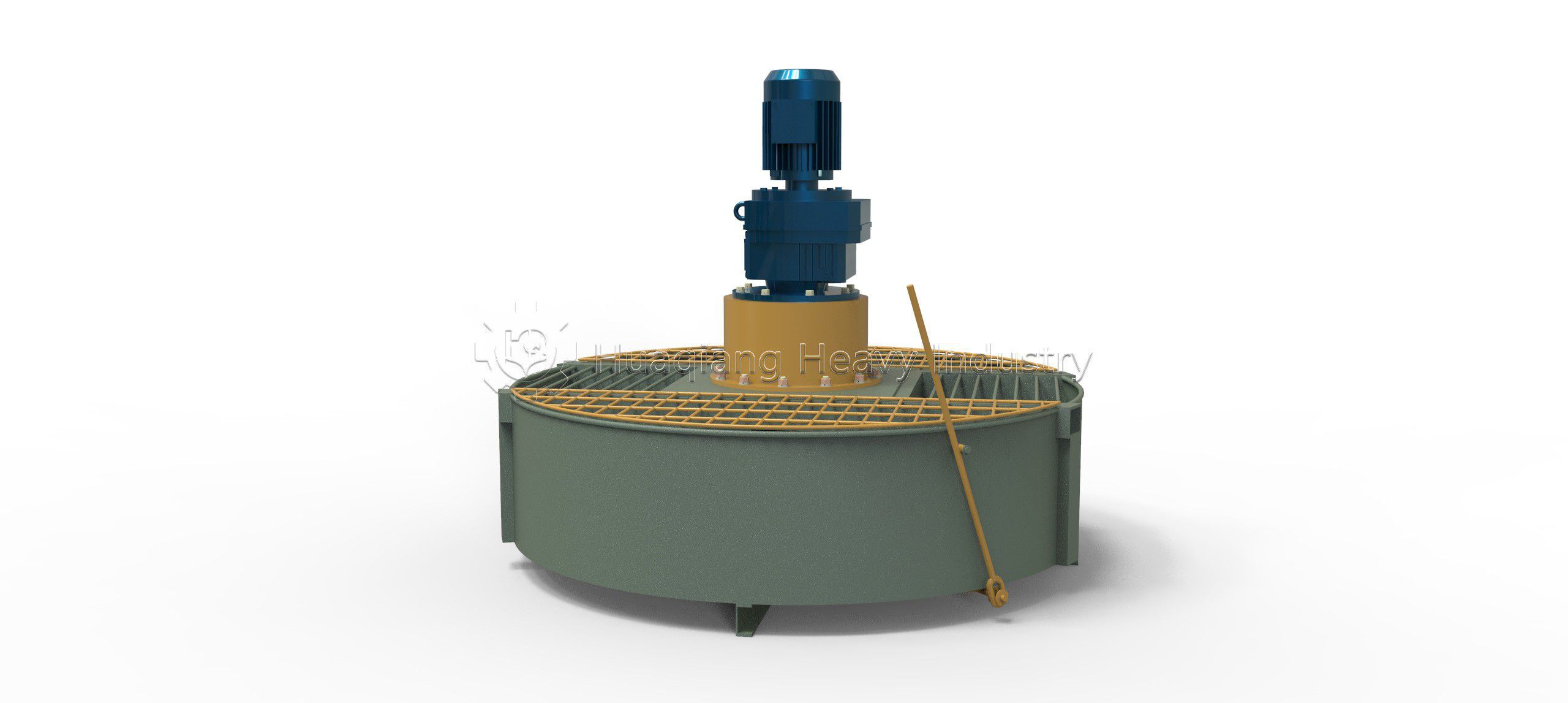
Vertical Disc Mixer

圆盘搅拌机.30

Vertical Disc Mixer

Vertical disc mixers are among the most widely used mixing equipment in industries such as fertilizer production, chemical processing, building materials manufacturing, and mining. This equipment uses a vertical disc as the container and stirring teeth as the tool, combining the advantages of three-dimensional mixing, anti-sticking and wear resistance, compactness, and high efficiency. With its outstanding advantages of high mixing uniformity, small footprint, low energy consumption, and easy maintenance, the vertical disc mixer has become a core piece of equipment in the mixing of powders, granules, and viscous materials.

In terms of key component design, the vertical disc mixer has been specifically optimized for the material characteristics of different industries. The inner wall of the disc is lined with polypropylene or stainless steel plates, making it less prone to material sticking and more wear-resistant. The stirring teeth are made of high-wear-resistant special alloys. An automatic scraping device is equipped to ensure that materials do not stick to the equipment during mixing. An atomizing nozzle can be added to the top to achieve uniform coating of liquid additives. The vertical disc mixer provides an efficient and reliable solution for material mixing in various industries with relatively low investment and operating costs.

Hardware configuration and component functions

The main hardware components of a vertical disc mixer include:

(I) Mixing disc assembly: A vertically mounted rotating disc lined with polypropylene or stainless steel plates.
(II) Mixing assembly: Mixing shaft, mixing arms, and mixing teeth.

(III) Transmission assembly: Electric motor, cycloidal pinwheel reducer, and coupling.

(IV) Frame assembly: Welded from high-quality carbon steel plates and channel steel.

(V) Feeding and discharging assembly: Top feed inlet and bottom discharge outlet.

(VI) Auxiliary system: Automatic scraper and atomizing nozzle.

Application footprint and audience distribution

Vertical disc mixers have a wide range of applications and target users:

Organic fertilizer production enterprises: Utilizing fermented livestock manure and straw to produce organic fertilizer. The equipment is typically located after crushing and screening and before granulation.

Compound fertilizer production enterprises: Using nitrogen, phosphorus, and potassium fertilizer powders to produce compound fertilizer.

Chemical enterprises: Mixing powders for fine chemicals, coatings, and additives.

Building materials enterprises: Mixing architectural coatings and insulation materials.

Mining enterprises: Mixing and blending mineral processing reagents.

Material range and processing capacity

Vertical disc mixers can process a wide range of materials, including powders, granules, and viscous materials. These include: fertilizers (organic fertilizer, compound fertilizer, potting soil, humic acid, etc.); chemicals (coatings, additives, chemical powders, etc.); and building materials (architectural coatings, insulation materials, etc.). Processing capacities range from 1 t/h to 16 t/h.

Operating Mechanism and Hybrid Principle

The vertical disc mixer operates based on the synergistic effect of centrifugal dispersion and gravity diffusion. A motor drives the disc to rotate at high speed. Material falls into the disc from the top inlet and is instantly carried to a high position by the mixing teeth. Under centrifugal force, the material moves radially outward along the disc. Under gravity, the material falls in a parabolic trajectory. Countless collisions, penetrations, and diffusions occur between particles. The residence time of the material in the disc can be precisely controlled by adjusting the disc rotation speed and the discharge port height. The entire process achieves rapid conversion from multi-component raw materials to a homogeneous mixture.

Hybrid process and production line coordination

Vertical disc mixers play a crucial role in production lines across various industries. The front end of the equipment receives crushed and screened materials; the equipment then performs three-dimensional mixing; after the mixed materials reach the required uniformity, they proceed to subsequent granulation and packaging processes. The uniformly mixed materials, upon entering the granulator, result in a higher pellet formation rate and more consistent particle strength. When applied to the soil, nutrients are released evenly, avoiding the risk of root and seedling burn caused by excessively high local concentrations. The equipment supports 24-hour uninterrupted stable production, fully adaptable to the needs of large-scale production.

All Services

Let's Start a Project

Call us directly, submit a sample or email us!

Office Address: NO.313, Wanshan Road, Xingyang City, Zhengzhou City, Henan Province, China
Contact With Us Call us: +86-18703630069