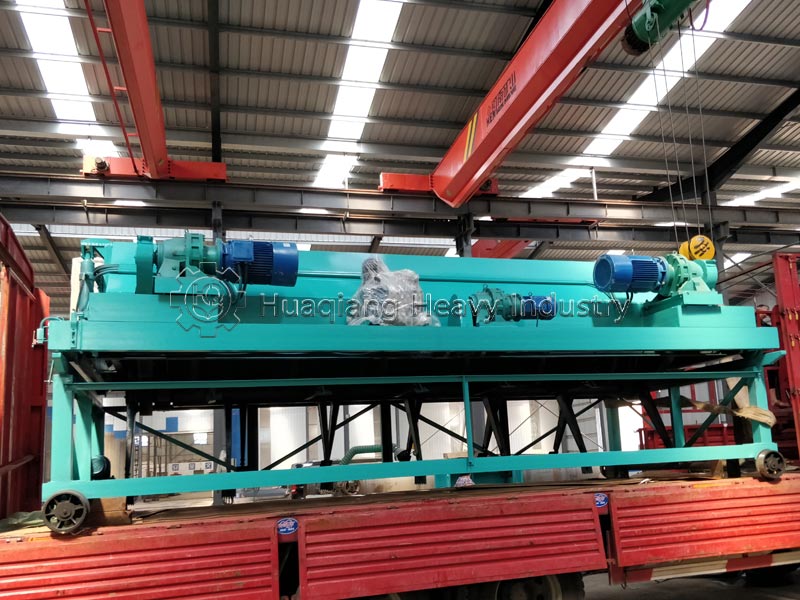

The hydraulic compost turning machine is a core piece of equipment for aerobic fermentation of organic solid waste. It is widely used in the production of organic fertilizers from livestock manure, straw, kitchen waste, and sludge. Compared to traditional composting equipment, it offers significant advantages in efficiency, automation, stability, environmental protection, and cost, making it suitable for large-scale, standardized organic fertilizer fermentation production lines.
The equipment adopts a hydraulic drive and trough-type track walking structure. The entire machine runs smoothly with high thrust, and the turning depth and speed can be flexibly adjusted according to material moisture and pile height. It provides uniform and thorough turning without dead ends, quickly breaking up material compaction, significantly improving oxygen supply efficiency, and allowing the fermentation pile to quickly heat up and cool down. This effectively kills pathogenic bacteria, insect eggs, and weed seeds, resulting in more thorough decomposition and stable, high-quality fertilizer.
High automation is a prominent feature. The entire machine is centrally controlled by a PLC, supporting one-button start/stop, automatic reciprocating motion, fixed-point turning, and remote monitoring. Operation is simple, requiring only one person to operate, significantly reducing labor input, labor intensity, and safety risks. The hydraulic system is powerful, responsive, and has a low failure rate. Walking, lifting, and turning actions are continuous and smooth, adapting to high-moisture, high-viscosity, and high-impurity materials. It is not prone to clogging or material sticking, and has strong versatility.
The equipment structure is robust and durable. The main beam, turning shaft, and blades are all made of high-strength wear-resistant materials, offering impact resistance and corrosion resistance, resulting in a long service life. Daily maintenance is simple, and operating costs are low. The trough body can be connected in parallel for continuous operation, resulting in high site utilization and flexible capacity expansion. It is suitable for long-term continuous production in small, medium, and large-scale organic fertilizer plants, combining economy and practicality, making it an ideal choice for modern organic material fermentation.