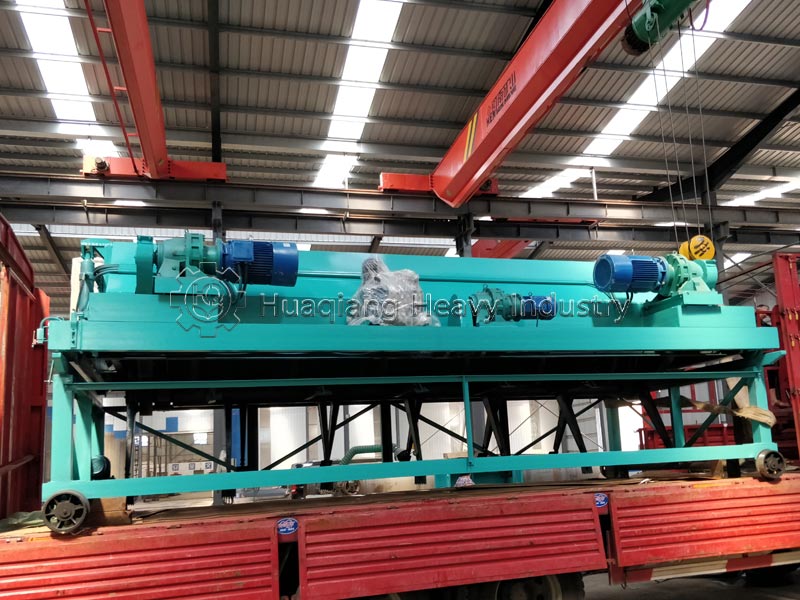

Choosing a hydraulic compost turning machine requires precise matching across four aspects: fermentation tank conditions, material characteristics, production capacity budget, and core configuration.
First, match the basic parameters of the fermentation tank: the turning width must match the tank width, and the turning height must cover the tank depth to ensure sufficient oxygenation of the compost pile; select the walking motor and track specifications according to the tank length, with high-power walking mechanisms preferred for long tanks. Multi-tank layouts can be equipped with a transfer carriage, allowing one machine to serve multiple tanks and reducing equipment investment.
Secondly, determine the machine model based on material characteristics: for high-moisture and sticky materials such as livestock and poultry manure and kitchen waste, choose a large-torque shaft and reinforced wear-resistant blades to prevent material clogging; for coarse fiber materials such as straw, use a powerful crushing blade shaft to improve dispersion and fermentation efficiency; for high-viscosity raw materials such as sludge and humic acid, prioritize hydraulic lifting and constant speed models to ensure uniform turning.
Next, select the model based on production capacity and budget: cooperatives and small production lines can choose small and medium-sized hydraulic lifting models, which are low in cost and easy to maintain; large-scale organic fertilizer plants should choose high-power, variable-frequency automatic models to support continuous and stable operation of the bio-organic fertilizer production line.
Finally, verify the core configuration and after-sales service: use a branded hydraulic station to ensure stable lifting and low failure rate; the blades should be made of high-manganese steel for wear resistance and durability, reducing replacement frequency; the motor must be fully sealed, waterproof, and dustproof to adapt to the high-humidity and corrosive environment of the fermentation workshop. Prioritize manufacturers with local service outlets and sufficient spare parts to ensure installation, commissioning, and subsequent maintenance.
By considering all these dimensions, you can select a composting machine that matches your fermentation process, production capacity requirements, and maintenance costs, ensuring the efficiency of organic fertilizer fermentation and the quality of the finished product.