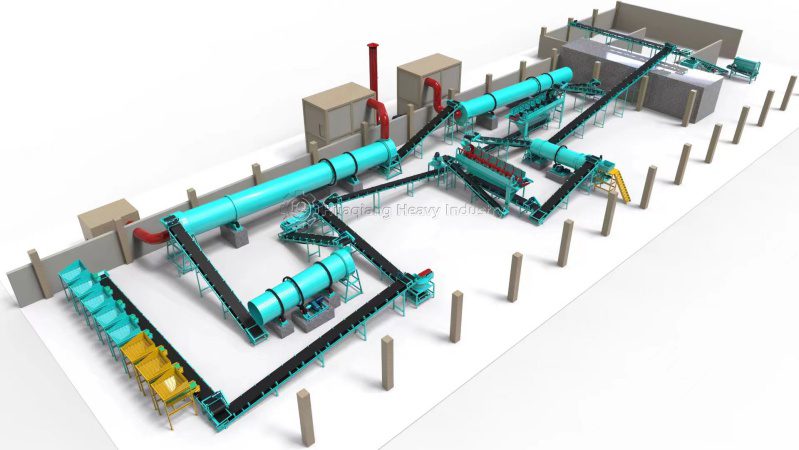

The root cause of fertilizer segregation in BB fertilizer production lines lies in significant differences in specific gravity and particle size among raw materials; factors such as inadequate mixing, large vertical drops during conveying, and excessive discharge speeds exacerbate this issue. Adjustments across three areas—raw material pretreatment, equipment modification, and operational practices—can effectively mitigate segregation.
Screening raw materials to ensure uniform specifications is fundamental. When sourcing, select NPK granules with similar sizes—avoiding combinations like small-particle monoammonium phosphate (MAP) with large-particle urea—and screen or crush any clumped fertilizer to eliminate extreme size disparities. Coated raw materials can be used; their higher surface friction makes them less likely to separate after mixing. Strictly control raw material moisture content; while excessively dry granules flow too freely and segregate easily, retaining a small amount of moisture promotes slight inter-particle adhesion, thereby reducing the likelihood of separation.
Optimize conveying and discharge processes. Minimize the vertical drop from the mixer to the packaging scale, keeping it within 80 cm; if the drop is too high, install buffer chutes or flow deflectors to reduce the impact force of falling material. Operate conveyor belts at low speeds and install flow-splitting baffles above the belt to prevent material from bouncing and segregating. Eliminate intermediate storage hoppers; convey the mixture directly to packaging after mixing to reduce static holding time, as segregation becomes more pronounced the longer the material sits undisturbed.
Standardize daily production operations. Empty residual material from hoppers whenever changing formulas, and separately pre-disperse fertilizers with significantly different specific gravities. Ensure synchronized and uniform feeding of ingredients to prevent a single raw material from surging into the mixer. Maintain moderate humidity in the workshop to reduce segregation caused by the rolling of dry materials; handle finished bags gently and prohibit dropping them from heights. Regularly calibrate mixer rotation speeds to prevent centrifugal segregation caused by excessive mixing speeds.
Implementing this comprehensive strategy keeps nutrient segregation deviations within acceptable limits, ensuring uniform nutrient distribution throughout each bag. This prevents uneven crop growth caused by segregation and helps maintain a stable product reputation among farmers.