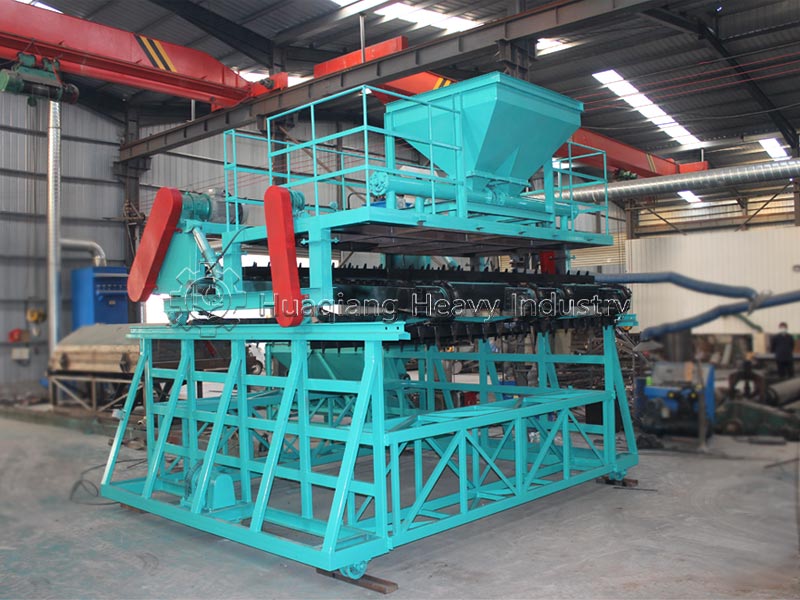

The chain compost turning machine serves as the core equipment in organic fertilizer fermentation production lines. The uniformity of turning, oxygen supply efficiency, and the rate of material maturation are influenced by a multitude of factors—including equipment configuration, material characteristics, operational management, and the fermentation environment—all of which directly determine the quality of the fermentation process and the pace of production.
First and foremost are the structure and configuration of the equipment itself. The rotation speed of the chain plates, the density of the rake-tooth arrangement, and the designed turning depth are of critical importance. If the rake teeth are worn, deformed, or spaced improperly, the result will be incomplete turning and the accumulation of unturned material. If the machine’s travel speed is too fast, the material will not be sufficiently broken up; conversely, if the speed is too slow, material is prone to piling up and backing up. Furthermore, if the machine’s vertical adjustment range is insufficient to accommodate varying pile heights, shallow-depth turning will occur, leading to oxygen deprivation in the bottom layers of the material and thereby hindering the fermentation process.
Secondly, the inherent characteristics of the materials themselves play a significant role. If the raw material moisture content is excessively high, the material tends to clump together, making it difficult to break up and aerate, which subsequently impairs ventilation and air permeability. Conversely, if the moisture content is too low, the material lacks sufficient looseness, resulting in a slower rise in temperature during fermentation. An improper ratio of straw or fibrous additives in the material mix—or the presence of manure that is excessively fine, dense, or viscous—will increase turning resistance and lead to uneven mixing. Additionally, if the material pile exceeds the equipment’s rated turning depth, the deep-seated layers of the material become difficult to turn over and aerate effectively.
Finally, site and environmental conditions are critical factors. Poor ventilation and insufficient air circulation within the fermentation facility mean that, even if the turning process itself is thorough, moisture cannot be dissipated nor air exchanged in a timely manner. Rainy, snowy, or humid weather, as well as low-temperature environments, increase the likelihood of material clumping and heighten the difficulty of the turning operation. Furthermore, a failure to regularly and promptly clean debris adhering to the chain plates and rake teeth will increase the equipment’s operational load and diminish its turning power, thereby negatively impacting overall operational efficiency over the long term.