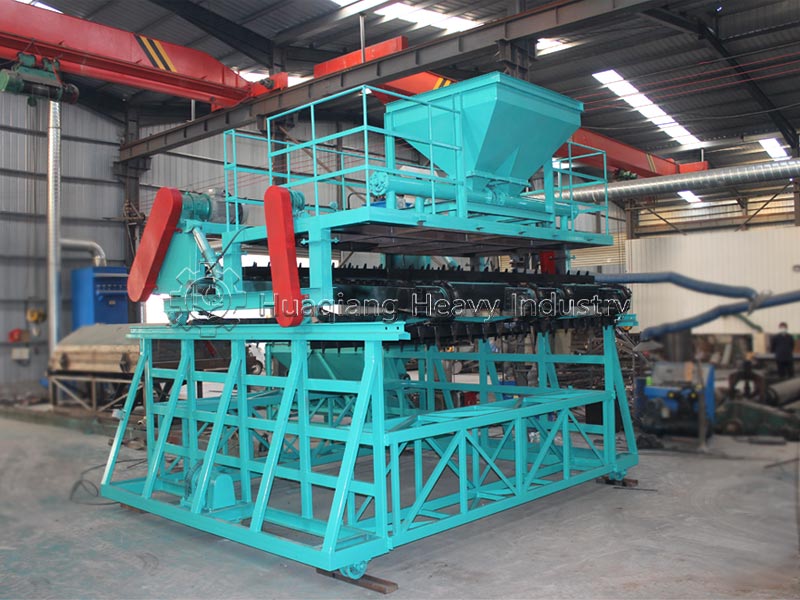

Chain compost turning machines offer high and stable fermentation efficiency. Their core advantages lie in sufficient turning depth, uniform oxygen supply, high processing capacity, and short cycle times, making them ideal for large-scale, trench-based fermentation operations.
- **Full-Depth Turning + Uniform Oxygen Supply:** Utilizing a layered operational approach—involving “bottom-layer scraping and conveying, mid-layer lifting, and top-layer crushing”—the machine can turn material in trenches ranging from 1.5 to 3 meters in depth. It effectively brings bottom-layer materials to the surface, maintaining a temperature differential within the compost pile of ≤5°C. This process reduces the anaerobic zone from 30% to less than 5%, effectively preventing the common issues of “bottom-layer anaerobiosis and surface overheating.” Oxygen penetration rates are increased by over 25%, ensuring stable microbial activity; consequently, the fermentation cycle is shortened from 25–30 days to 15–20 days, and under certain operating conditions, can be reduced to as little as 10–12 days.
- **High and Continuous Processing Capacity:** With an operating width of 2–4 meters and a travel speed of 0.5–1.5 meters per minute, a single unit can turn 30–80 tons of material per hour. For a trench measuring 3 meters deep and 50 meters long, a single pass takes only 2–2.5 hours—50% faster than traditional equipment. The use of anti-stick chain plates and hydraulic drive systems minimizes downtime caused by material adhesion, resulting in longer effective daily operating hours and a 30%–50% increase in overall production capacity.
- **Strong Material Adaptability:** The chain-plate system, equipped with toothed pallets, forcibly lifts and scatters the material, achieving a lump-crushing rate of 90%. This design makes it highly suitable for processing high-moisture and high-viscosity materials (such as livestock manure and sewage sludge) without becoming jammed.
- **Efficiency Limitations:** The operating width per pass is limited, requiring the trench to be processed in sections. Furthermore, deep-trench applications require the installation of robust guide rails and specialized travel mechanisms, resulting in slightly higher maintenance costs compared to smaller-scale equipment.
Overall, both the operational efficiency and the quality of the finished product produced by this equipment are significantly superior to those of traditional compost turners, making it an ideal choice for large-scale organic fertilizer fermentation production lines with a daily output exceeding 100 tons.