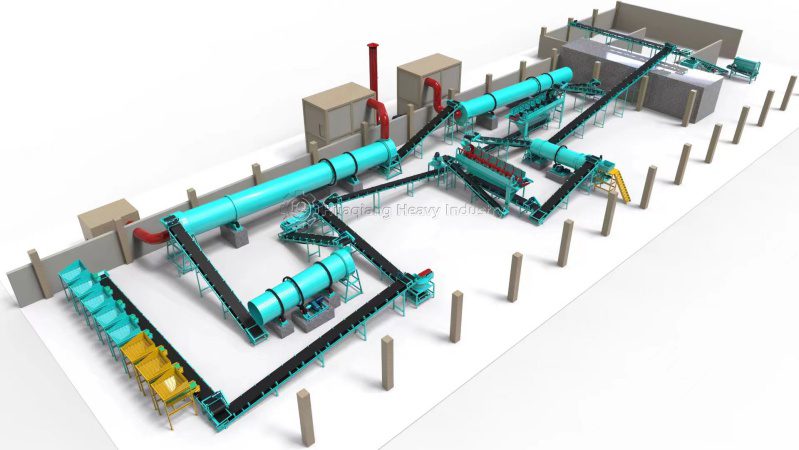

Smooth feeding is crucial for ensuring accurate batching, uniform mixing, and continuous production in an NPK blending fertilizer production line. To achieve stable feeding, comprehensive control is needed from multiple aspects, including raw materials and process control, to prevent problems such as bridging, blockage, and uneven feeding from the source.
Raw material pretreatment is fundamental. Nitrogen, phosphorus, and potassium raw materials should have uniform particle size, be free of lumps and dust, and avoid excessive fine powder that can cause sticking to the silo. The moisture content of the raw materials should be controlled within a reasonable range; excessive moisture can cause adhesion to the inner wall, forming bridging and affecting the smoothness of feeding. The mixing of straw, plastic bags, stones, and other foreign objects is strictly prohibited to prevent blockage of the discharge port.
The silo structure design is critical. The silo inclination angle should be no less than 60°, and the inner wall should be made of polished stainless steel or smooth plate to reduce material friction and adhesion. The discharge port should be appropriately enlarged, avoiding a narrowed design to prevent material jamming. The lower part of the silo can be made into a conical or hyperbolic structure to further improve flowability.
Process control must be scientific and reasonable. Variable frequency drive (VFD) discharge control and low-flow start-up prevent congestion caused by excessive instantaneous material discharge. A multi-bin static batching system discharges material sequentially and evenly, ensuring stable flow. The NPK blending machine monitors material level and discharge status in real time during operation, automatically activating the anti-bridging device in case of abnormalities.
Daily maintenance is crucial. Regularly clean residual material from the hopper walls to prevent hardening; check the air lines, motors, and vibration devices for proper functioning to ensure effective operation of the flow-aiding equipment.
Through these measures, the stability of NPK blended fertilizer discharge can be significantly improved, achieving no bridging, no blockage, and no material interruption, ensuring efficient and continuous operation of the production line.