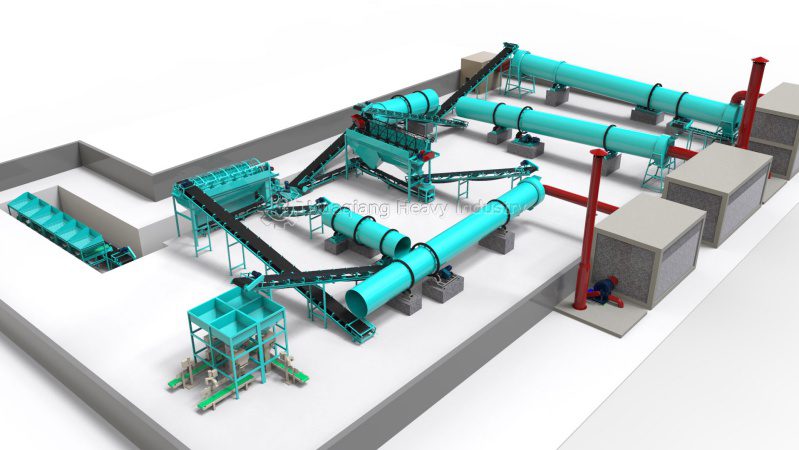

The organic fertilizer produciton line and BB fertilizer production line differ completely in their process principles, core equipment, and production objectives, and are suited to significantly different categories of fertilizers.
First, Production Principles: BB fertilizer utilizes a physical dry-blending method, involving only the precise proportioning and uniform mixing of granular nitrogen, phosphorus, and potassium raw materials; it involves no chemical reactions, fermentation, or granulation. Organic fertilizer, conversely, uses organic materials—such as livestock and poultry manure or crop straw—as raw inputs; these require biological fermentation and maturation, followed by a combination of biochemical and physical processing steps—such as crushing, conditioning, granulation, and drying—to alter the physical and chemical properties of the materials.
Second, Core Equipment: The core components of a BB fertilizer production line consist of automatic batching scales, specialized granular mixers, and screening and packaging machines; it requires no fermentation, granulation, or drying equipment. Gravity-free mixers are commonly employed to protect the granules and prevent breakage. Organic fertilizer production, however, necessitates fermentation windrow turners, crushers, and horizontal fermentation tanks; these are paired with disc or roller granulators, as well as rotary dryers and coolers. The mixing process in this context focuses on crushing and homogenizing high-moisture materials.
Third, Raw Materials and Finished Product Forms: The raw materials for BB fertilizer are pre-manufactured fertilizer granules and slow-release fertilizers, characterized by uniform particle sizes. The finished product consists of loose granules with readily available nutrients and flexible nutrient ratios. The raw materials for organic fertilizer are primarily agricultural and livestock waste, rich in organic matter. The finished product takes the form of either matured powder or shaped granules, and its production requires strict assurance of organic matter content.
Fourth, Energy Consumption, Lead Time, and Cost: The BB fertilizer production process is short, requires no heat source for drying, occupies a small footprint, allows for rapid commissioning, and features low energy consumption. Organic fertilizer production, conversely, involves a lengthy fermentation cycle, high energy consumption for drying and cooling, and a more extensive array of supporting equipment, resulting in higher capital investment for infrastructure and greater operational and maintenance costs.
Fifth, Focus of Quality Control: Quality control for BB fertilizer places strict emphasis on batching accuracy and mixing uniformity, aiming to prevent granule breakage and segregation. Quality control for organic fertilizer focuses on the degree of fermentation and maturation, moisture regulation, the retention of organic matter, and the efficiency of granulation and shaping.