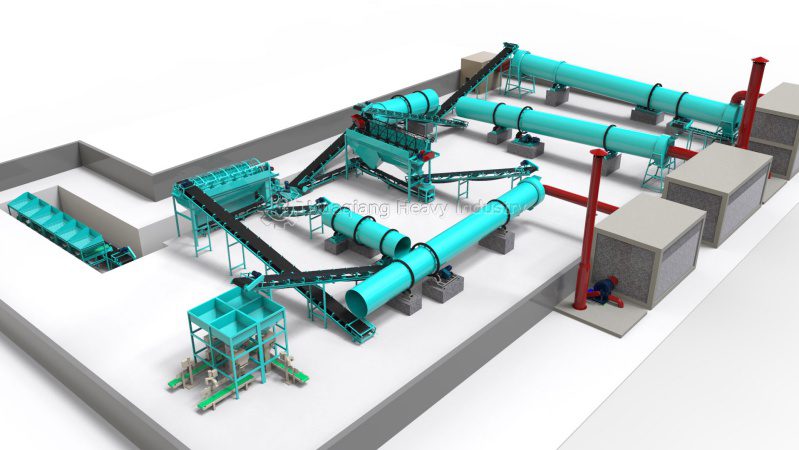

Dust in NPK blending fertilizer production lines mainly occurs during the feeding, crushing, batching, mixing, conveying, and packaging stages. By combining measures such as sealing, negative pressure, speed reduction, dust removal, humidification, and standardized operation, dust emissions can be significantly reduced, improving the workshop environment.
Sealed feeding hoods and negative pressure dust extraction ports are installed at the raw material feeding inlets to prevent dust spillage during manual feeding. Crushing and screening equipment are fully enclosed, with flexible connections for sealing to reduce dust leakage.
The batching and mixing system is entirely sealed. Sealed conveying systems are used between silos, metering hoppers, and mixers to reduce material impact from drops. A guide cover is installed at the mixer outlet to prevent direct material spillage and dust generation.
For conveying, enclosed NPK bulk blending machine such as scraper conveyors, screw conveyors, and bucket elevators are preferred, minimizing open conveyor belts. Shortening the conveying height and drop reduces material impact, reducing dust generation at its source.
Pulse jet baghouse dust collectors are installed at key dust-generating points. Suction vents are positioned above the feeding, crushing, mixing, and packaging areas to create a negative pressure environment. Collected dust is recycled and reused, which is both environmentally friendly and saves raw materials.
Appropriate control of raw material moisture content is crucial. Slight humidification can effectively suppress dust, but excessive moisture should be avoided to prevent clumping and material blockage. Packaging machines are equipped with dust covers and dust collection ports, and telescopic sleeves are added to the packaging openings to reduce dust generation during bagging.
Standardized equipment operation and maintenance, timely replacement of seals, and cleaning of accumulated material prevent pipe blockages and material leakage that could cause secondary dust generation. Through full-process sealing, negative pressure dust collection, and process optimization, workshop dust can be significantly reduced, meeting environmental protection production requirements.