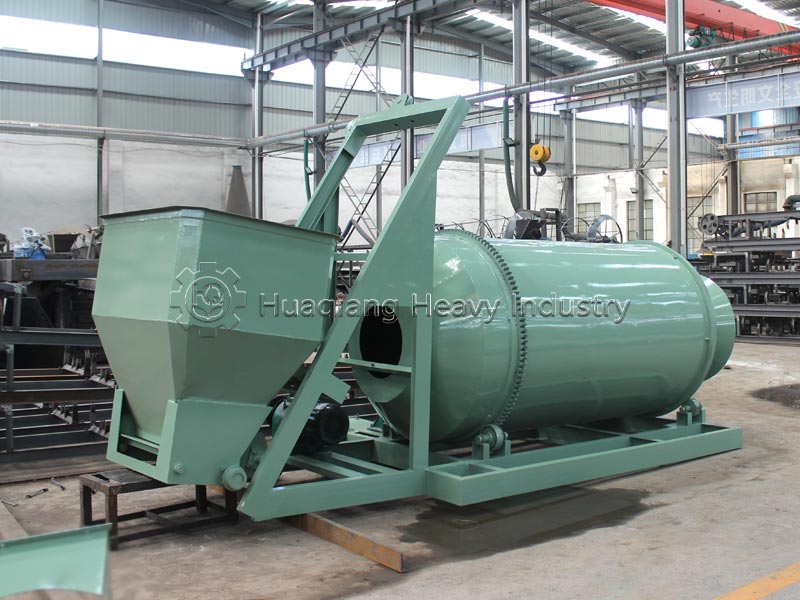

Insufficient mixing uniformity in BB fertilizer production lines is the most common quality problem, primarily stemming from three main areas: equipment, raw materials, and operating processes.
Firstly, there are issues with the fertilizer production machine itself. Severely worn, deformed, or damaged blades in the twin-shaft mixer weaken the mixing thrust, preventing sufficient convection and shear mixing of materials. Excessive material accumulation on the machine walls reduces the effective volume and mixing space. Inappropriate mixing speeds—too high a speed causing material to float, too low a speed resulting in insufficient tumbling—all directly contribute to uneven mixing.
Secondly, there are significant differences in the physical properties of the raw materials. Nitrogen, phosphorus, and potassium raw materials vary greatly in particle size, specific gravity, and roundness, easily leading to segregation and stratification. Some raw materials become damp and clump together, and these hard lumps cannot be broken up, resulting in localized nutrient accumulation after mixing. Inconsistent moisture content and fluidity of the raw materials, along with inconsistent feeding speeds, result in inadequate mixing during stirring.
Furthermore, improper feeding sequence and methods can also cause problems. Simultaneous feeding of multiple raw materials at once results in insufficient time for the light and heavy materials to fully blend; direct, large-scale input of small proportions of trace elements without pre-diluted and pre-mixed processes makes uniform dispersion difficult.
Furthermore, improper process parameter settings lead to overloading of the machine, insufficient tumbling stroke, and inadequate mixing time, resulting in discharge before the standard mixing duration is reached, naturally leading to low uniformity.
Finally, secondary segregation occurs during the discharge and conveying process. After mixing, the lifting, unloading, and conveying processes cause particles of different specific gravities to separate again. While the mixture may appear uniform, uneven nutrient distribution is observed in the final product packaging.