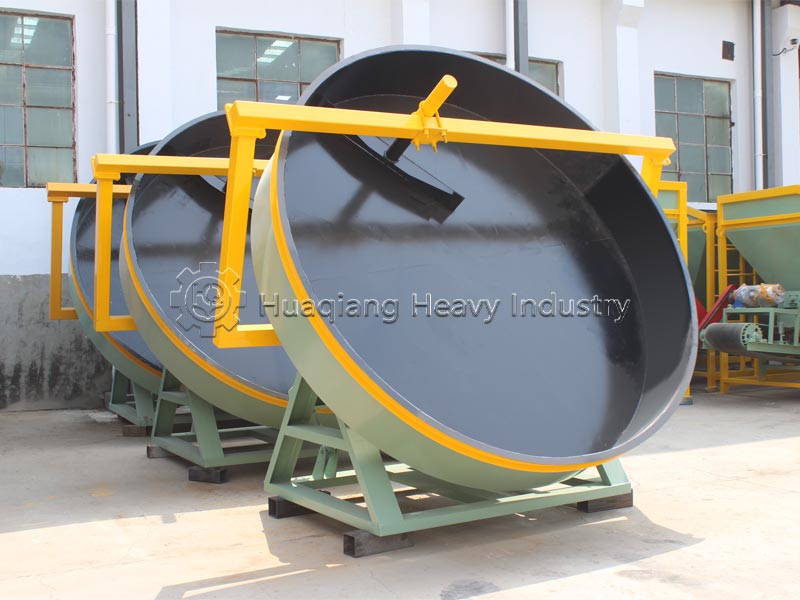

Improving the pelletizing rate of bio disk organic fertilizer granulators hinges on the coordinated efforts of four aspects: raw material pretreatment, moisture control, equipment parameter matching, and operational process optimization. Achieving uniform powder, moderate moisture content, smooth rolling, and proper binding can stably increase the pelletizing rate to 85%–95%.
First, strictly control the fineness and uniformity of the raw materials. The ideal particle size is 1.5–3 mm. Too coarse a particle size makes it difficult to agglomerate, while too fine a particle size leads to dust and clumping. Fully fermented materials have stable moisture content and uniform texture, resulting in better pelletizing and significantly reducing material return.
Second, properly match the disc operating parameters. The inclination angle is generally controlled between 35° and 45°, and the rotation speed between 15 and 25 r/min, ensuring that the material is both lifted and rolls smoothly, forming a good rolling granulation trajectory. Too large an inclination angle or too high a rotation speed results in a short material residence time and a low pelletizing rate; conversely, it easily sticks to the disc and clumps.
The guiding properties of the binder and masterbatch are also crucial. Adding appropriate amounts of bentonite, humic acid, or a specialized binder can enhance powder adhesion. Retaining a portion of qualified granules as masterbatch at startup quickly guides the agglomeration of new material, reducing ineffective rolling and significantly improving pelleting speed and yield.
Finally, ensuring uniform, continuous, and stable feeding in the disc granulation production line avoids uneven particle size caused by inconsistent feed amounts. Combined with proper screening and return material recirculation, overall pelleting rate and particle roundness can be further improved.
Through these measures, high pelleting rate, uniform particle size, good strength, and stable output can be achieved, meeting the requirements of large-scale organic fertilizer production.