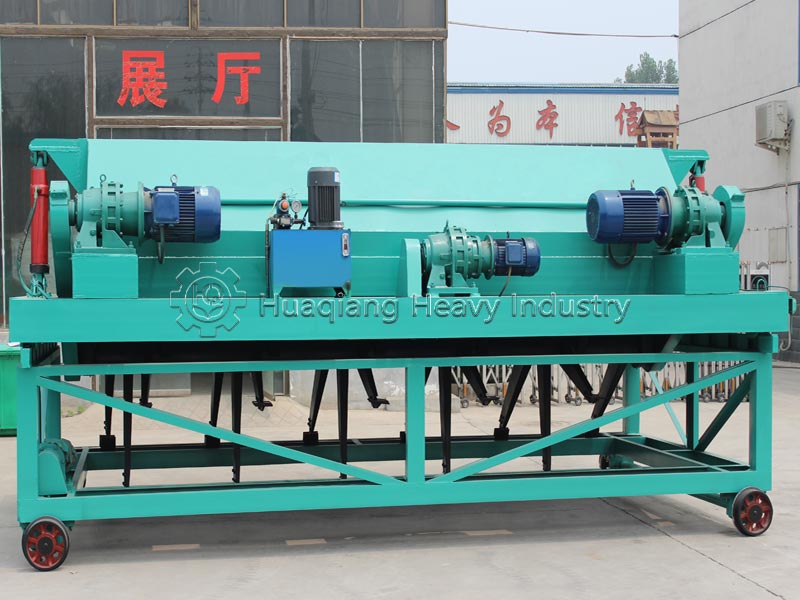

Hydraulic compost turning machines and simple compost turning machines are two commonly used pieces of equipment for organic fertilizer fermentation. Their core differences lie in their structure, performance, applicable scale, and cost; their overall positioning is completely different.
Simple trench compost turners have a simple structure, mostly consisting of a fixed frame with ordinary turning rollers, using chain or gear transmission, and lacking hydraulic lifting adjustment. They are inexpensive to manufacture and easy to install, suitable for small-scale farmers or small fertilizer plants with small production volumes and small trenches. However, their turning depth is fixed and cannot be flexibly adjusted. They are prone to jamming and overloading when handling high-moisture, high-viscosity materials. Furthermore, their travel speed is limited, resulting in generally lower fermentation uniformity and weaker durability, leading to a higher failure rate over long-term use.
Hydraulic trench compost turners are equipped with hydraulic lifting and hydraulic speed control systems. The height of the turning rollers is freely adjustable, adapting to different fermentation depths and material moisture conditions. They automatically avoid hard lumps or clumps, effectively protecting the main shaft and blades. The machine boasts a robust frame and stable transmission, making it suitable for large-span, deep fermentation tanks. This allows for deeper turning and turning, larger processing capacity, more uniform fermentation, and faster composting.
In terms of durability, the hydraulic version utilizes high-power, wear-resistant components, ensuring smooth operation and a low failure rate. It is suitable for large-scale organic fertilizer plants and centralized manure treatment in livestock farms. Although the purchase cost is higher than the basic version, it offers reasonable energy consumption, lower maintenance costs, and a longer service life.
Simply put, the basic version is suitable for small-volume, low-cost initial fermentation; the hydraulic version is suitable for large-scale, high-standard, continuous production lines. The two differ significantly in production efficiency, adaptability, and stability.