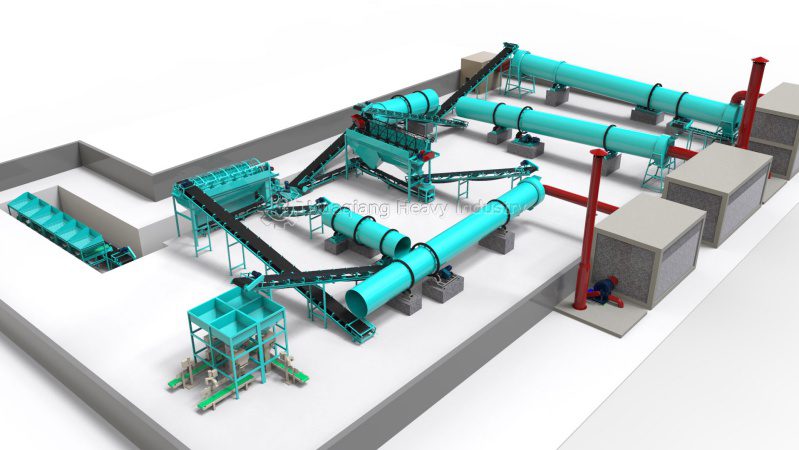

The core reason why NPK blending fertilizer production lines need to be customized and designed specifically for different customers is that raw materials, output, formulas, site conditions, and standards vary greatly. A standardized NPK blending machine cannot meet all production needs; only a tailored design can ensure accurate proportioning, stable operation, and reasonable costs.
Different customers use significantly different raw materials. Urea, ammonium phosphate, potassium chloride, potassium sulfate, and trace elements vary in specific gravity, particle size, hygroscopicity, and corrosiveness. Raw materials prone to clumping require anti-bridging devices; raw materials containing chlorine and strong corrosiveness require corrosion-resistant equipment; raw materials with a high concentration of fine powder require enhanced sealing and dust removal. Without a customized design, problems such as unstable feeding, uneven mixing, and excessive corrosion can occur.
Customers’ output and production models vary greatly. Small farmers producing a few tons per day are suitable for simple semi-automatic production lines; large factories, export companies, and agricultural input groups producing tens or hundreds of tons per day require fully automatic, continuous, and high-configuration production lines. Different production volumes necessitate adjustments to the number of ingredient silos, mixer specifications, packaging speed, and control systems to avoid wasted investment or insufficient capacity.
Standards and formulation requirements vary across regions. Domestic conventional fertilizers, export-grade fertilizers, high-end functional fertilizers, and specialty fertilizers containing trace elements have different requirements for proportioning accuracy, mixing uniformity, and anti-stratification. Export and high-end fertilizers require higher-precision ingredient mixing systems, and varied formulations necessitate multi-silo designs with flexible switching capabilities.
Each customer’s plant size, terrain, power supply, and budget also differ. Narrow spaces require compact layouts; height limitations necessitate lower equipment heights; and limited budgets prioritize core precision. Uniform equipment is often unsuitable for installation or inefficient.
In summary, NPK blended fertilizer production lines are specifically designed to adapt to raw materials, meet production demands, comply with standards, suit different sites, and control costs, ensuring the equipment is truly user-friendly, durable, precise, and economical.