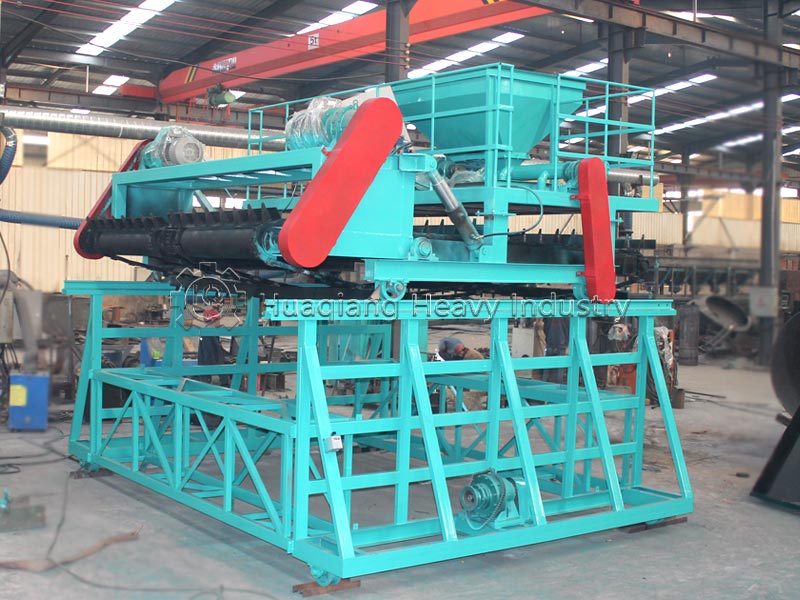

The primary advantage of the chain compost turning machines lies in its capacity for deep-trench, high-pile, and high-load fermentation. Compared to wheel-type or drum-type turners, it offers superior deep-trench capability, higher space utilization efficiency, and greater output.
The standard turning depth of a chain-plate compost turner ranges from 1.5 to 3 meters, while certain reinforced models can reach depths of up to 3.5 meters. Utilizing continuously rotating rigid chain plates and turning teeth, the machine is able to lift, break apart, and redistribute the entire mass of material from the very bottom of the pile. This ensures a complete interchange between the bottom, middle, and top layers, facilitating uniform oxygen supply and eliminating any “dead zones” within the fermentation pile.
Deep-trench operation offers several distinct advantages. First, it minimizes land footprint. For a given daily production volume, deeper trenches mean fewer trenches are required; this reduces the overall site area and lowers civil engineering costs, making it ideal for large-scale organic fertilizer plants. Second, it enhances fermentation efficacy. The increased thickness of the material pile improves heat retention and accelerates temperature rise, consistently maintaining a stable range of 60–70°C. This ensures thorough sterilization and maturation, accelerates decomposition, and shortens the overall fermentation cycle to just 15–20 days. Third, it delivers high processing throughput. By concentrating material in deep trenches, a single machine can process between 80 and 120 cubic meters per hour, making it well-suited for continuous production in large- and medium-scale organic fertilizer fermentation production lines. Fourth, it is highly effective with high-moisture and viscous materials. The chain plates possess strong penetrating power—preventing slippage or “floating” of the machine—and are impervious to high moisture levels, high fiber content, or material clumping; they are highly resistant to jamming or material adhesion.
However, two key points must be observed when utilizing deep-trench systems. First, the trench structure itself requires proper waterproofing, ventilation, and track leveling. Second, the moisture content of the raw materials must be maintained within the 50%–65% range; excessive moisture can cause material to adhere to the chain plates, thereby compromising the turning process and air permeability. Routine operational practices—such as maintaining a steady travel speed, periodically lubricating the chains, and clearing away any entangled debris—are sufficient to ensure the long-term, stable operation of the deep-trench system.
In summary, the chain-plate compost turner demonstrates that “deeper means more cost-effective,” “deeper means higher yield,” and “deeper means superior fermentation.” Consequently, it has emerged as the mainstream equipment choice for deep-trench fermentation applications in modern large- and medium-scale organic fertilizer production facilities.