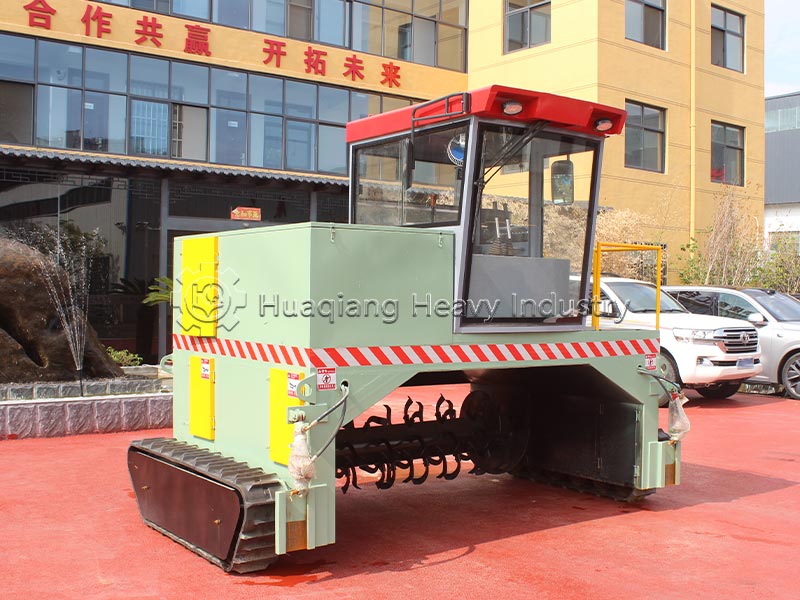

First, they offer greater adaptability to different terrains. Wheeled compost turners rely on tires for movement, making them prone to slipping and sinking in muddy, manure-saturated, or soft soil conditions, hindering their ability to reach the compost pile. Windrow compost turners, with their larger contact area and lower pressure, can operate even on damp, muddy ground around the manure pile. They can also operate in wet greenhouses or after rain without needing to be dried out, making them more practical for small to medium-sized open-air fermentation sites.
Second, they offer better compatibility in terms of turning depth and material selection. Wheeled compost turners typically have a maximum turning depth of less than 1 meter, making it difficult to thoroughly turn highly moist chicken or pig manure, which tends to stick to the rake teeth. Tracked compost turners, on the other hand, can reach depths of 1.2–1.8 meters, effectively breaking up sticky, well-rotted manure and sludge mixtures. This results in more even oxygen supply to the pile, a more stable fermentation cycle, and flexible adjustments for both wide and narrow piles.
Thirdly, tracked machines offer high operational stability. The lateral thrust generated during the turning and dumping of large material piles makes wheeled machines prone to being pushed off course and veering off course. Tracked machines provide strong grip, preventing the machine from swaying under heavy loads, ensuring uniform turning and minimizing variations in the finished product’s decomposition. Most tracked models are equipped with hydraulic lifting and remote control, allowing for quick and easy adjustment of the rake tooth height, and can be operated remotely by a single person.
Fourthly, tracked machines offer higher site utilization. Wheeled machines require a wide aisle, while tracked machines have a smaller turning radius, allowing for narrower stacking distances and enabling the storage of more raw materials in the same space. The only drawback is that tracked machines experience wear and tear over time, but their overall adaptability to various working conditions far surpasses that of wheeled machines.
Customers with damp raw materials, simple open-air sites, or those who produce chicken and duck manure year-round should prioritize tracked machines; those with dry and loose raw materials, hardened and level sites, and lower budgets should consider wheeled models.