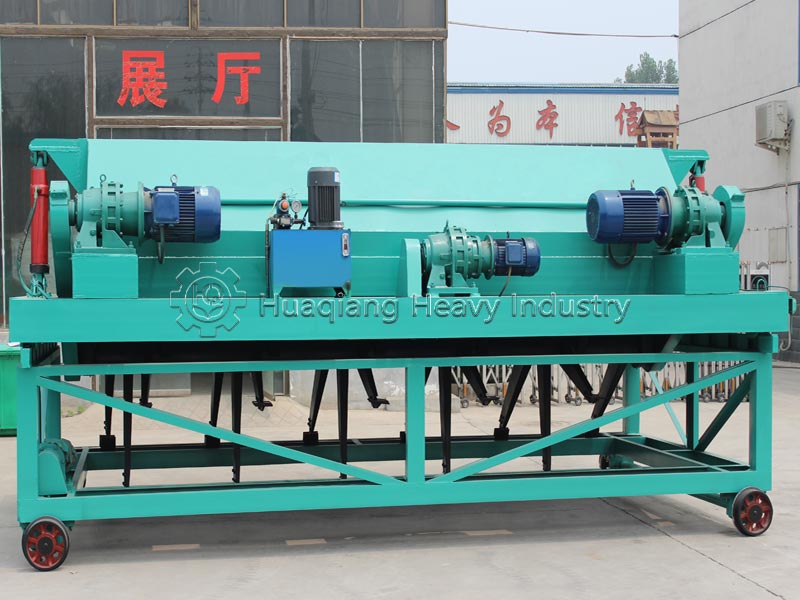

The stable operation and turning quality of hydraulic compost turning machines are highly dependent on the dimensions, structure, track, and foundation construction precision of the fermentation tank. Strict matching of equipment parameters is essential during tank construction; otherwise, problems such as deviation, jamming, missed turning, and uneven turning can easily occur.
Firstly, there are requirements for tank dimensions. The tank width must precisely match the span of the turner. Standard tank widths are generally 3–6 meters, calculated as: tank width = equipment working width + 0.4–0.6 meters. A 0.2–0.3 meter safety clearance should be left on each side to prevent the rake teeth from rubbing against the walls. The tank depth is typically 1.2–2.5 meters, accommodating the maximum lifting stroke of the turner. The distance between the rake tips and the tank bottom should be 50–100 mm to avoid scraping or missed turning. Tank lengths are typically 20–50 meters, and can be flexibly designed according to site conditions and production capacity.
Secondly, there are requirements for tank structure and drainage. The fermentation tank must be constructed of reinforced concrete with a wall thickness ≥200 mm and a strength of C25 or higher to prevent settlement and deformation. The tank bottom should have a 0.5%–1% slope towards the drainage end to ensure smooth drainage of leachate and prevent water accumulation that could affect fermentation. The top surface of the tank wall must be level and straight, with a straightness error ≤3 mm/meter to prevent track tilting and equipment deviation.
Furthermore, track installation accuracy is crucial. Light rails with a draw weight of 18 kg/m or higher are generally used, fixed parallel to the top surface of the tank wall. The track gauge should match the equipment span, with an error ≤5 mm. Track joints must be smooth and secure, with a total height difference ≤5 mm; otherwise, it will lead to vibration, derailment, and increased load on the hydraulic system.