

In fertilizer manufacturing, NPK bulk blending (BB fertilizer) lines and roller extrusion granulation lines represent two distinct process pathways: the former relies on purely physical mixing, while the latter involves high-pressure forming. These methods are not mutually exclusive; effective synergy creates a flexible “mixing plus granulation” production system capable of meeting diverse product demands, ranging from standard blended fertilizers to granular products.
The core of a BB fertilizer line lies in “accurate formulation and uniform mixing.” A complete NPK bulk blending line consists of a series of components: raw material silos, a metering system, mixing equipment, and a packaging machine. Granular raw materials—such as urea, ammonium phosphate, and potassium chloride—are stored separately. During production, electronic scales weigh them precisely according to the formula, keeping the error margin within ±0.2%. The core equipment—the NPK bulk blending mixer—utilizes a twin-shaft paddle structure; the two mixing shafts rotate in opposite directions, creating a three-dimensional tumbling motion for the materials. This achieves a mixing uniformity of over 95%, effectively preventing particle segregation. The mixing process is gentle, discharge is rapid, and operation is stable, ensuring the original granular form of the materials remains largely intact. The entire production line is PLC-controlled, supports the storage and management of over 20 formulas, and allows for formula switching within minutes.
Segregation is the primary technical challenge in BB fertilizer production. There is a significant difference in specific gravity between urea (bulk density approx. 1.33 g/cm³) and potassium chloride (approx. 1.98 g/cm³); if handled improperly after mixing, they tend to separate. Preventing segregation requires control at the source: raw materials must have similar particle size distributions (matched SGN indices), with differences kept within ±0.5 mm. Post-mixing, belt conveyors replace chutes to minimize free-fall height, and buffer silos equipped with anti-segregation baffles are installed prior to packaging. A staged discharge method is employed: one-third of the material is discharged first, followed by a 30-second pause to allow the remaining material to continue tumbling and mixing before the final discharge.
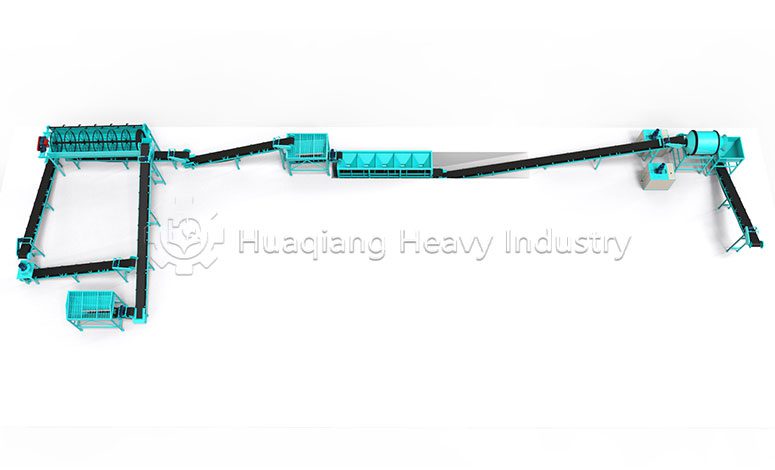
Roller extrusion granulation offers an alternative pathway for dry granulation. The double-roller press granulator employs a purely physical, high-pressure forming process: powdered materials are squeezed into sheets between two high-pressure rollers and subsequently crushed and screened to produce granules. The entire operation takes place at ambient temperature, requiring no added water, drying, or binding agents. Raw material moisture content is controlled between 8% and 12%, the roller gap is adjusted to 0.52 mm based on the target particle size, and extrusion pressure is set at 8–15 MPa for organic fertilizer and 15–25 MPa for compound fertilizer. Unlike disc granulation—which requires adjusting moisture content to 25%–30% followed by drying—roller extrusion eliminates the need for coal-fired hot-air furnaces, rotary dryers, and coolers, shortening the process flow by nearly 40%. The entire production line features a compact layout and zero emissions of waste gas, wastewater, or solid waste, making it particularly suitable for regions with strict environmental regulations or for enterprises sensitive to energy consumption.
The synergistic value of these two production lines lies in their complementarity. The BB (Bulk Blend) fertilizer mixing process excels at handling granular raw materials and rapidly producing blended fertilizers, whereas the double-roller press granulation technology excels at processing powdered materials to produce high-strength granules. Bio-organic granules produced by bio-organic fertilizer equipment can serve as a raw material for the BB fertilizer line—mixed proportionally via an NPK blending machine—if further blending with chemical fertilizers is required. Conversely, substandard fines screened out from the BB fertilizer line can be fed into the roller press granulation line for re-granulation, achieving zero material waste. This flexible combination of processes endows the production line with dual capabilities—blending and granulation—thereby maximizing equipment utilization and product added value.