

The fundamental difference between a BB fertilizer production line (also known as a bulk blending line) and a traditional compound fertilizer line lies in the production method: the former involves purely physical mixing, while the latter relies on chemical reactions. BB fertilizer lines eliminate complex processes such as granulation, drying, and cooling; instead, they directly physically blend base fertilizers—such as large-granule urea, monoammonium phosphate (MAP), and potassium chloride—according to soil-testing-based formulas to create finished products with flexible N-P-K ratios. This “physical combination rather than chemical synthesis” model requires only one-third of the investment of a compound fertilizer line with equivalent capacity, reduces energy consumption by over 60%, and generates no waste emissions.
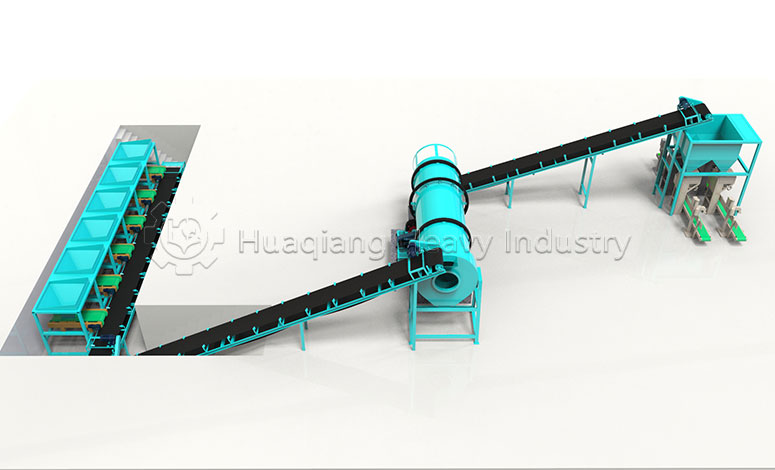
What components make up the production line?
A standard BB fertilizer production line consists of four main modules: raw material storage and conveying, dynamic batching and metering, mixing/blending, and finished product packaging. Raw materials are fed into respective buffer silos via bucket elevators and then dynamically metered—based on preset formulas (e.g., 15-15-15, 17-17-17)—using variable-frequency screw feeders or electronic belt scales at the silo outlets, keeping metering errors within ±0.2%. The materials then enter a twin-shaft paddle mixer, where high-speed agitation by specially angled paddles ensures rapid, uniform blending within 30–90 seconds, achieving a coefficient of variation (CV) of ≤5%. The entire line utilizes PLC automation, fully automating the process from batching to packaging.
What is the most difficult challenge in production?
Particle segregation is the primary technical challenge in BB fertilizer production. Due to differences in particle size (typically 2–4 mm) and specific gravity among raw materials like urea, ammonium phosphate, and potash, stratification tends to occur during mixing and conveying. The key to solving this lies in matching raw material particle sizes; the granules must be of similar size, otherwise segregation will occur later even if the mixture is initially uniform. Modern, high-end production lines are equipped with anti-segregation distribution devices and online particle size monitoring systems to ensure consistent nutrient distribution in every bag of fertilizer.
How much space and investment are required for a BB fertilizer production line? BB fertilizer production lines feature a compact, tower-style or tiered layout, requiring a footprint of only 60–100 square meters; hourly capacities ranging from 5 to 30 tons correspond to a total power requirement of 15–45 kW. The core of the system lies in the synergy between the precision of the batching unit and the mixing uniformity of the blender. For agricultural input distributors transitioning to branded fertilizers or large-scale planting operations establishing their own blending stations, BB fertilizer production lines—with their advantages of low investment, quick returns, and flexible formula switching—have become key equipment for completing the “soil testing–formulation–production–application” closed-loop process.