

In discussions regarding the selection of equipment for dry-type extrusion granulation, a common source of confusion is the tendency to compare individual machines, equipment categories, and entire production lines as if they were on the same level. A “double roller press granulator” refers to a specific type of forming machine; “fertilizer roller press machine” is a general term for a category of equipment operating on this specific process principle; and a “roller press granulator production line” denotes a complete system that integrates feeding, extrusion, crushing, screening, material recycling, and packaging into a continuous process. These three concepts exist at different levels and address fundamentally different questions.
At the level of an individual machine, the core question is: “Can pressure be applied to the material in a stable and consistent manner?” A double-roller press utilizes two high-strength, counter-rotating rollers to compress dry powder into dense sheets or “cakes” at ambient temperature. The bonding forces between particles—such as van der Waals forces, adsorption, and crystalline bridges—are generated without the addition of water or the application of heat. A key advantage is that once the operating parameters are locked in, the density and strength of the granules depend primarily on the stability of the material feed. However, there are clear operational boundaries: the moisture content must generally be kept below 5%, and the feed particle size should not exceed 0.6 mm. Exceeding these limits can lead to slippage between the rollers or an inconsistent material layer, resulting in a significant decline in the uniformity of granule strength. When selecting an individual machine, the focus should not be on its nominal capacity, but rather on whether the specific material falls within this narrow operational window.
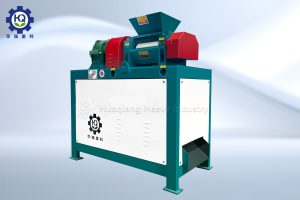
At the level of equipment categories, the term “fertilizer roller press machine” encompasses a range of models that share the same fundamental process principles but differ in their specific structure and configuration. While they all rely on the core logic of dry-type extrusion, they vary in aspects such as roller diameter, hydraulic system design, roller surface materials, and crushing mechanisms. At this level, the question to answer is, “Which category of equipment is best suited for my specific material and product objectives?”—rather than simply, “Which machine is the cheapest?” Within the category of roller compaction, different machine models are optimized for different purposes—some are geared toward producing high-hardness granules, while others are designed to handle heat-sensitive or hygroscopic formulations. Choosing the wrong type cannot be compensated for, regardless of how impressive the individual machine’s specifications may appear.
At the production line level, a roller press granulation system addresses the challenge of transforming individual mechanical actions into a repeatable, continuous output. A complete line typically includes feeding and metering systems, a forced-feed mechanism, the core roller press, a crusher, multi-stage screening equipment, and a packaging unit. The screening stage creates a closed loop: oversized granules are crushed and recycled back into the process, while on-spec granules are directed to the finished-product silo. The true value of a production line lies not in the power rating of any single piece of equipment, but in the quality of the integration between all stages. Unstable feeding leads to fluctuations in compaction; inefficient screening causes a buildup of recycled material; and an uncontrolled recycle ratio can severely bottleneck the entire line’s throughput. While this process eliminates the drying stage required for wet granulation, it necessitates that both the incoming material conditions and the downstream screening/recycling loop be managed under a unified control system.
The selection process should follow a three-tiered hierarchy: first, verify that the material meets the moisture content and particle size requirements for dry compaction; second, determine which type of compaction equipment aligns with your product goals; and finally, address the configuration of the entire production line and its level of automation. Treating a complete production line as a single piece of equipment leads to an underestimation of integration costs, while comparing an entire line against a standalone machine results in a misjudgment of actual production capacity. The reliability of dry compaction is never determined by a single set of rollers; rather, it depends on each of these three levels effectively maintaining its own operational parameters.