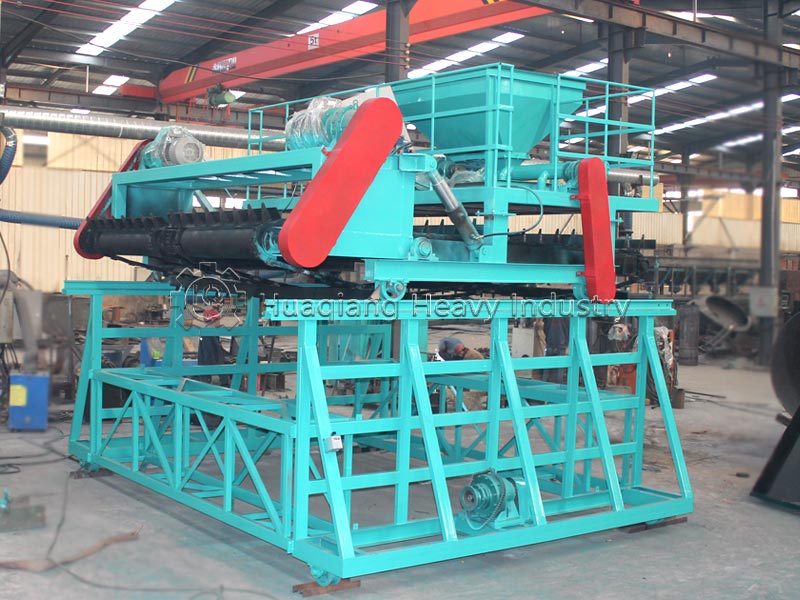

The chain compost turning machine is the core equipment for aerobic fermentation in organic fertilizer trough systems. It is suitable for large-scale fermentation of livestock and poultry manure, straw, and other raw materials. Utilizing a chain plate scraping and lifting/spreading operation method, its process characteristics are well-suited to bio organic fertilizer production lines, with distinct advantages and application boundaries. The core characteristics are as follows:
Its core process advantages are prominent: the composting operation depth can reach 1.5-3.5m, allowing for sufficient spreading of anaerobic materials at the bottom and contact with air, resulting in high oxygen penetration and maintaining a composting temperature of 55-65℃, shortening the fermentation cycle to 7-15 days; the operating width is 2-8m, with a daily processing capacity of 500-5000m³, and it can operate continuously in single or multiple troughs along the track, connecting with upstream and downstream equipment to form an integrated production line, meeting the needs of tens of thousands of tons of large-scale production. Furthermore, the low-speed operation of the chain plate minimizes material damage, reduces nutrient volatilization, and maintains a high organic matter retention rate. It can also handle high-moisture, viscous raw materials with 60%-75% moisture content, preventing material sticking and machine jamming. The compost pile has good ventilation after turning, avoiding anaerobic fermentation.
The process is adapted to a fixed trough layout, requiring concrete fermentation troughs and tracks. It allows for layered gradient turning, continuous feeding and discharging, and improves space utilization by more than 40%; the entire machine has no complex hydraulic system, and its energy consumption is only 60% of that of hydraulic composting machines, resulting in low operating costs and low supporting requirements. It can be used in existing factory renovations, requiring only adjustments to the composting frequency based on the raw materials.
Daily maintenance is simple, with easily replaceable wear parts such as chain plates and track wheels. Maintenance per shift takes no more than 30 minutes. However, there are limitations: the equipment has poor mobility and can only operate in designated troughs; the trough foundation needs to be horizontally calibrated; and the initial investment is high, making it unsuitable for small-batch decentralized production with a daily processing capacity of <500m³.