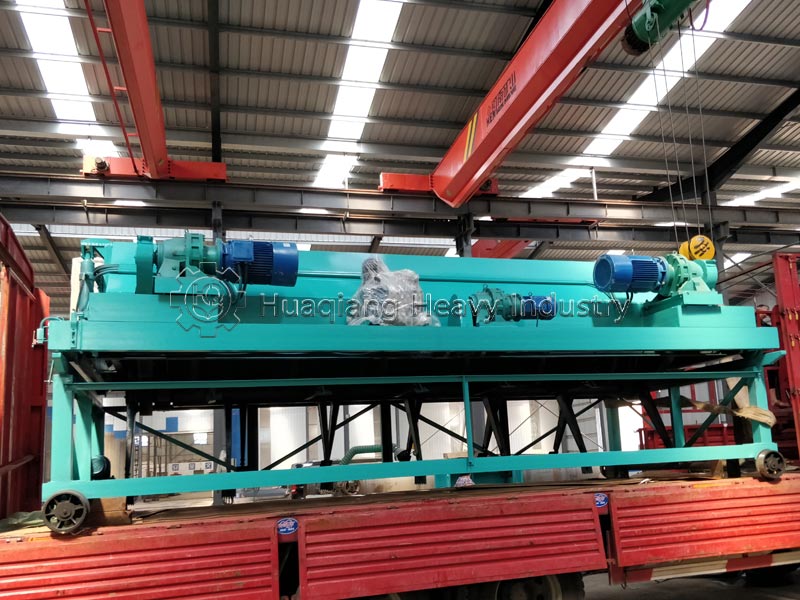

The turning depth of a hydraulic compost turning machine is primarily controlled by a hydraulic system that raises and lowers the turning shaft. Precise adjustment is achieved through limit switches and operating parameters, making it easy to operate and adaptable to different fermentation needs.
During adjustment, the hydraulic control valve is operated to drive the cylinder to extend and retract, causing the turning shaft to rise and fall as a whole. This directly changes the distance between the rake teeth and the bottom of the trough, thus setting the turning depth. It can typically be adjusted as needed within the range of 0.5–1.2 meters. Before operation, raise and lower the turning shaft under no-load to the target height, ensuring the rake teeth do not scrape against the bottom of the trough while maintaining a small safety clearance to avoid damage to components from hard friction.
The accompanying mechanical limit device can lock the maximum and minimum depths to prevent depth deviation caused by cylinder depressurization, ensuring consistent operation. To address changes in material thickness, the hydraulic valve can be fine-tuned during operation to raise and lower the turning shaft in real time, adapting to the pile height and ensuring sufficient turning and oxygenation of the bottom material.
To improve the uniformity of turning and mixing, the rotation speed and travel speed of the turning shaft can be adjusted. A faster rotation speed and slower travel speed result in more thorough turning, and vice versa. Matching the turning speed with the depth of rotation and travel speed will lead to better fermentation results in the organic fertilizer fermentation production line.
Daily checks are necessary on the hydraulic cylinder seals and the sensitivity of the limit switches. Aged seals should be replaced promptly to prevent oil leaks or loss of depth control, ensuring stable turning depth and meeting the oxygen supply, temperature rise, and maturation requirements of organic fertilizer fermentation.