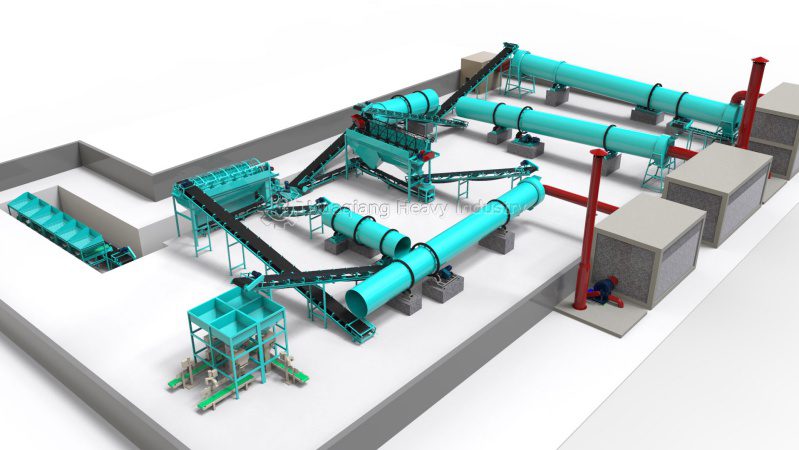

BB fertilizer mixers are the core equipment in NPK blending fertilizer production lines. They are primarily used to uniformly mix various granular fertilizers according to a formula, ensuring balanced and consistent nutrient content in the product. This is a key piece of equipment for achieving standardized BB fertilizer production. The equipment is typically a horizontal twin-shaft or single-shaft structure, characterized by fast mixing speed, high uniformity, no segregation, clean discharge, and stable operation.
During production, the BB fertilizer mixer uses forced mixing via spiral or paddle blades to rapidly convection, diffusion, and shearing of raw materials with different specific gravities and particle sizes, achieving high uniformity mixing in a short time. This meets the stringent requirements of BB fertilizer for nutrient uniformity. Its reasonable structural design ensures smooth feeding and discharging, and it can be linked with automatic batching systems and packaging machines to achieve automated continuous production, significantly improving production efficiency.
To ensure mixing quality and equipment lifespan, the feed rate must be controlled within the rated range during use to avoid overload, which can lead to weak mixing, motor overheating, or component damage. Materials should be kept dry, loose, and free of large clumps to prevent jamming, uneven mixing, or accelerated blade wear. The mixing time should be adjusted according to the formula; too short a time will result in uneven mixing, while too long a time will reduce efficiency and increase energy consumption.
Daily maintenance focuses on checking bearing temperature, chain or belt tension, and motor current; regularly adding grease; and tightening loose bolts. After each shift, promptly clean any residual material from the machine to prevent fertilizer from absorbing moisture and clumping, corroding the inner walls and blades, and extending the equipment’s lifespan.
A stable BB fertilizer mixer can effectively improve the quality of BB fertilizer products, reduce nutrient deviations, and lower production costs, making it a crucial guarantee for the efficient and stable operation of blending fertilizer production lines.