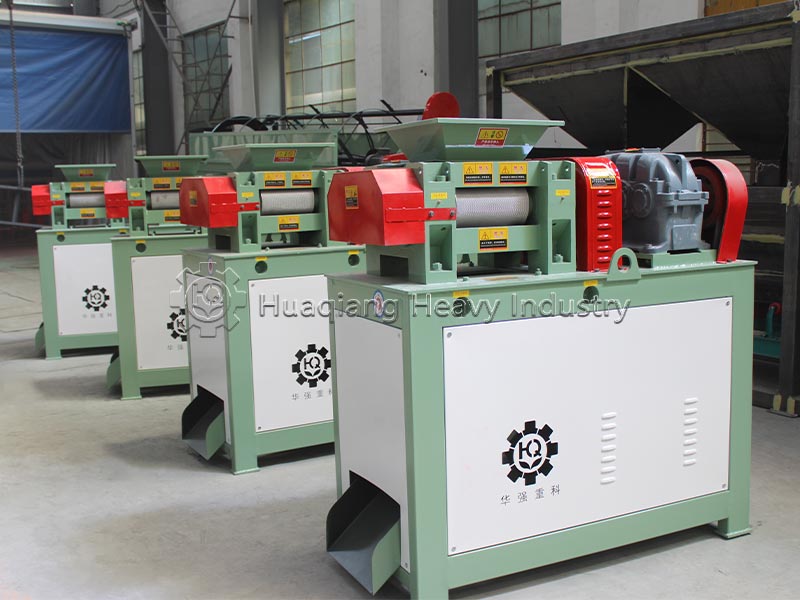

By standardizing the operational procedures for the double roller press granulator produciton technology—as well as optimizing raw material control and equipment management—it is possible to effectively reduce equipment failure rates, extend the service life of core components (such as roller shells, bearings, and transmission systems), and ensure continuous, stable production.
Raw material control serves as the fundamental basis for reducing equipment failures. The moisture content of raw materials must be strictly controlled, typically maintained within the range of 5% to 10%; excessive moisture can lead to material sticking to the rollers and clogging, while excessive dryness results in poor granulation quality and accelerated wear. Raw material particle size should be uniform; the entry of large lumps, hard objects, or metal impurities into the machine chamber must be prevented to avoid damage to the roller shells, sudden shutdowns, and impact shocks to the main shaft. Installing an iron-removal device at the feed inlet can effectively mitigate potential failure risks at the source.
The feeding process must be continuous, uniform, and quantitative; sudden, massive batch feeding or attempting to start the machine under heavy load from an empty state is strictly prohibited. Excessive load fluctuations can cause uneven wear on the roller shells, sudden stress shifts on the bearings, and unstable motor currents, potentially triggering issues such as vibration, abnormal noises, or jamming. Maintaining a stable feeding rate allows the equipment to operate under a reasonable load, thereby significantly reducing the frequency of equipment failures.
It is essential to strengthen process coordination and equipment maintenance. Regular inspections of the roller shell gap and wear status should be conducted, with timely adjustments or replacements made as needed. Ensure that components such as bearings, gears, and couplings are adequately lubricated and properly sealed to prevent dust ingress, which can lead to premature wear. During operation, closely monitor the motor current, temperature, and operational sounds; if any anomalies are detected, immediately shut down the machine in accordance with procedural guidelines to troubleshoot the issue, thereby preventing minor problems from escalating into major equipment failures.
Furthermore, proper procedures for clearing residual materials upon shutdown must be implemented to prevent material residue from caking or causing corrosion to the equipment due to moisture exposure. Through comprehensive process optimization and standardized operational practices, the failure rate of double-roller extrusion granulators can be significantly reduced, leading to improved production efficiency and an extended equipment service life.