

The concept of soil-test-based formula fertilization has been promoted for decades, and the processes of soil sampling, laboratory analysis, and formula development are well-established. However, a persistent and awkward gap has long existed: while agricultural technicians calculate precise NPK ratios based on test reports, the actual production stage often forces them to “make do” with generic compound fertilizers available on the market that only approximate the ideal formula. The formula is precise, yet the fertilizer is generic—this is the gap bridged by NPK blending production lines (also known as BB fertilizer lines).
The core value of an NPK blending production line lies in its ability to directly translate data instructions from soil-test formulas into actionable physical blending operations. Unlike traditional compound fertilizer lines that require complex chemical processes such as high-temperature granulation, drying, and cooling, BB fertilizer production is essentially a purely physical mixing process. Pre-granulated basic fertilizers—such as large-granule urea, monoammonium phosphate (MAP), and potassium sulfate—are blended directly according to the formula data, with no chemical reactions involved throughout the process.
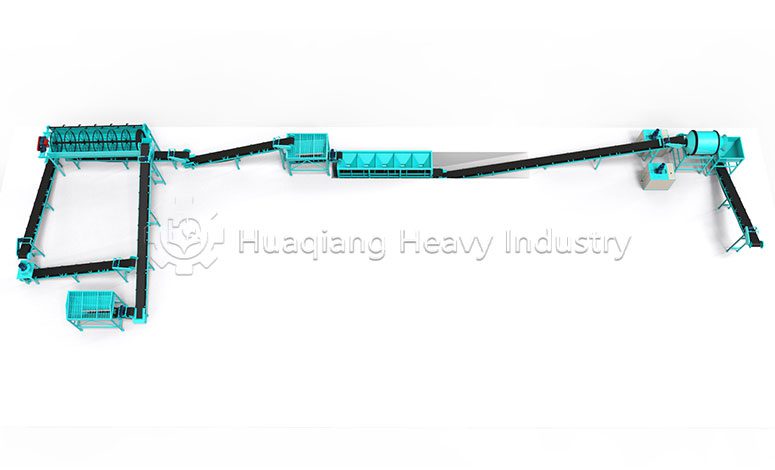
A standard NPK blending production line consists of four main modules: a raw material storage and conveying system, a dynamic batching and metering system, a mixer, and an automatic packaging system. At the start of production, basic fertilizers are conveyed via bucket elevators into their respective buffer bins. Variable-frequency screw feeders or electronic belt scales at the bin outlets then perform dynamic, cumulative metering based on the preset formula. Equipped with high-precision sensors and intelligent weighing control algorithms, the batching system keeps metering errors within ±0.2%, with some high-end models achieving ±0.1%. The system employs a two-stage feeding method—”fast feed” followed by “slow feed”—to ensure that the nutrient ratio of every batch precisely meets design specifications.
Once batching is complete, the materials enter the blender. The equipment utilizes a twin-shaft paddle or “zero-gravity” mixing structure; driven by specially angled paddles, the materials achieve rapid, uniform mixing within 30 to 90 seconds, maintaining a coefficient of variation for mixing uniformity below 5%. The entire production line utilizes centralized PLC control, automating the full process from ingredient proportioning and mixing to final packaging, allowing operators to monitor the entire line from a central control room.
The NPK blending production line is not a substitute for traditional compound fertilizer lines but rather a product of the precision agriculture era. It employs the simplest physical methods to transform soil-test-based “prescriptions” into tangible fertilizer products ready for bagging. As the fertilizer industry shifts from selling generic products to providing customized solutions, the value of this production line is only just beginning to be redefined.