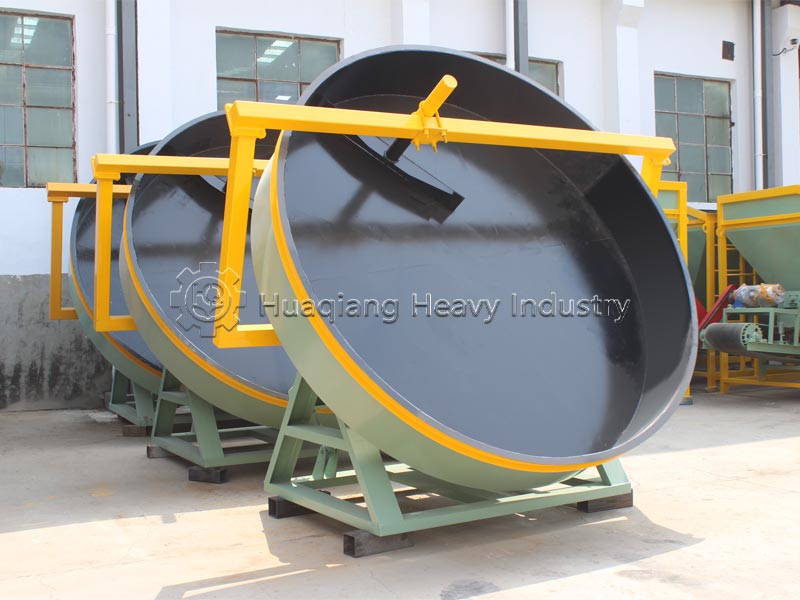

The organic fertilizer disc granulator machine utilizes a process of ambient-temperature rolling agglomeration. It is a widely adopted wet granulation method for the production of organic fertilizers, bio-organic fertilizers, and compound fertilizers, characterized by a stable workflow and a high granulation rate.
First, fermented and fully matured organic raw materials—or N-P-K compound powder blends—are processed through a pulverizer to achieve the required particle fineness. These materials are then transferred to a mixer, where binders, microbial agents, and other additives are introduced according to a specific formula and thoroughly blended to ensure uniform consistency in both flowability and cohesiveness. The blended powder is conveyed uniformly into the bio disc organic fertilizer machine, which rotates at a fixed inclination angle and speed. Simultaneously, an appropriate amount of water is sprayed via atomizing nozzles, causing the powder within the rotating pan to continuously roll, adhere, and agglomerate, thereby gradually forming tiny granular nuclei.
As the material continues to tumble, the granules progressively adsorb additional powder and grow in size. Once they reach the target particle diameter, they automatically overflow from the rim of the disc, marking the completion of the preliminary granulation stage. The discharged wet granules are then fed into a dryer, where they undergo low-temperature drying to remove excess moisture and prevent caking. Subsequently, they pass through a cooler to reduce their temperature and stabilize their structural integrity.
The cooled granules are classified using a screening machine; granules meeting the quality specifications proceed to the subsequent packaging stage, while undersized fragments and fine powders are recycled back to the granulator for reprocessing. Throughout this entire process, parameters such as the disc’s inclination angle, rotational speed, and water spray volume can be adjusted based on the specific characteristics of the raw materials to precisely control the size and sphericity of the resulting granules.
This process requires neither high temperatures nor high pressures, making it biologically friendly and ideally suited for processing organic substances and heat-sensitive raw materials. The complete bio-organic fertilizer production line features simple equipment integration and convenient operation; the resulting granules are round, uniform, and possess moderate structural strength, establishing this method as a mainstream granulation technology for small-to-medium-sized fertilizer manufacturing plants.