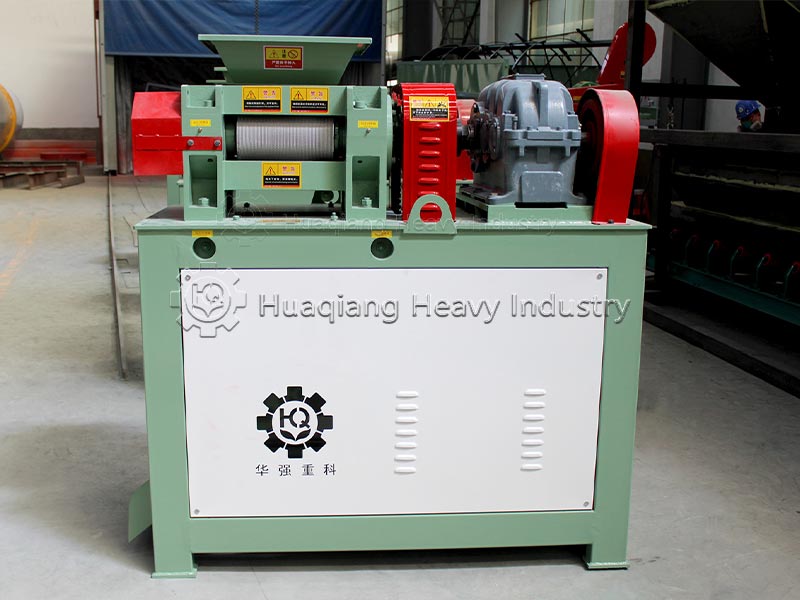

Insufficient granule hardness, looseness, and powdering in granules produced by double roller press granulator produciton technology are mostly caused by a combination of issues related to raw materials, moisture, pressure, equipment, and process. Specific reasons are as follows:
Improper Raw Material Moisture Content:** Excessive moisture prevents compaction between the rollers, resulting in large internal voids and soft, brittle granules. Insufficient moisture leads to poor material cohesion, making it difficult to form after extrusion and resulting in insufficient hardness.
Improper Raw Material Fineness and Proportioning:** Overly coarse material particles result in insufficient contact during extrusion, preventing even pressure distribution. Materials with a high proportion of nitrogen and potassium fertilizers and poor viscosity are inherently weak and difficult to compact without additives.
Insufficient or Unstable Extrusion Pressure:** Low hydraulic system pressure, pressure leakage, or oil leaks can lead to insufficient pressure between the rollers. Belt slippage and insufficient motor power can also prevent pressure from reaching the required level, resulting in only “light” compression rather than “compact” compression.
Uneven or Inconsistent Feeding Speed:** Spiral feeding jams and inconsistent feed amounts cause uneven material thickness between rollers, resulting in large pressure fluctuations. Some particles are compacted while others are not, leading to overall low hardness.
Severe wear of key components. Long-term use causes wear and deformation of the roller skin and die grooves, resulting in insufficient material compression depth and low forming density. Excessive bearing clearance and frame vibration also affect pressure stability, leading to insufficient particle hardness.
Improper control of subsequent processes. Excessively high rotation speed in the crushing and screening stage can crack and shatter already formed particles. An excessive proportion of returned material and too much fine powder can also reduce the overall strength of the finished product particles.