

The fundamental difference lies in the production method. Traditional compound fertilizer lines fuse nutrients into the interior of each granule through chemical reactions; in contrast, NPK blended fertilizer lines (also known as BB fertilizer lines) utilize a purely physical mixing process, precisely weighing and uniformly blending granules of base fertilizers—such as nitrogen, phosphorus, and potassium—according to a specific formula. Since the entire process requires no heating, drying, or chemical reactions, it offers the advantages of low investment, low energy consumption, and rapid implementation.
How does the production line “blend” the different granules together?
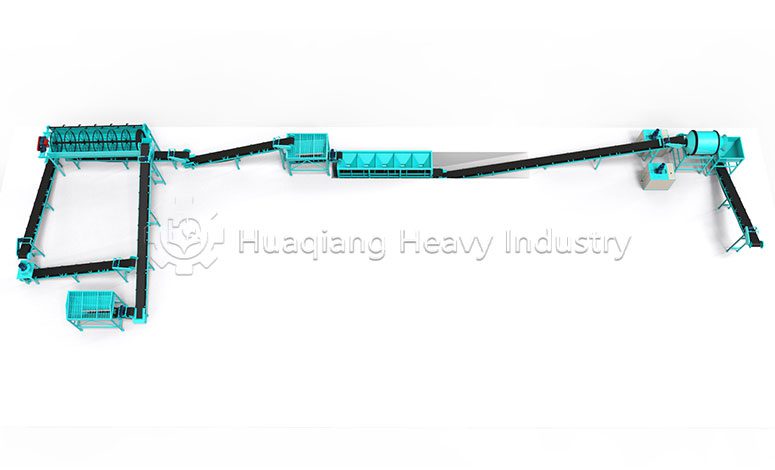
The core process of the line is clear and efficient, comprising the following main steps:
Raw material preparation and storage: Base fertilizer granules—such as urea, monoammonium phosphate (MAP), and potassium chloride—are stored in separate silos.
Automatic precision batching: This is the “heart” of the production line. A PLC control system follows a preset formula to instruct high-precision electronic scales to weigh each raw material automatically; the batching error margin is kept within ±0.2%, ensuring accurate nutrient ratios.
Efficient, uniform mixing: The weighed materials are fed into a specialized mixer (such as a twin-shaft paddle mixer or a rotary drum mixer). Over a period of 2–5 minutes, gentle tumbling action thoroughly blends the different granules without damaging their original shape. Mixing uniformity can exceed 95%.
Finished product packaging: The blended product enters a buffer hopper, where an automatic packaging scale handles weighing, bagging, and sealing.
What is the most challenging issue in production, and how is it resolved?
The most challenging issue is granule segregation. Because different raw materials vary in particle size and specific gravity, they tend to separate into layers during mixing, conveying, and packaging, resulting in uneven nutrient distribution within the package.
Addressing this requires a two-pronged approach involving production line design and raw material control:
Equipment design: Employ gentle mixing methods and optimize conveying and discharge stages to minimize vibration and drop heights.
Raw material control: This is the fundamental solution. It is essential to ensure that the particle size distributions of the different raw materials are similar, thereby reducing the risk of segregation at the source.