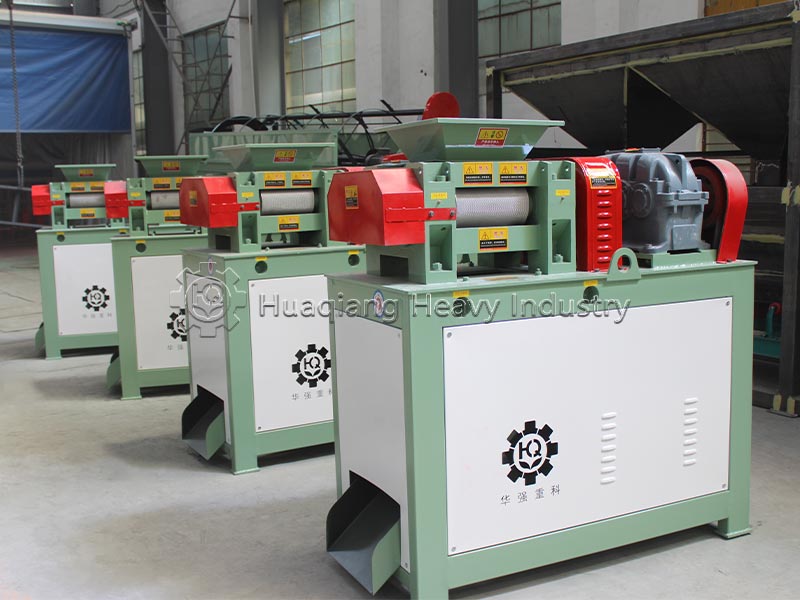

The output of a double roller press granulator is not a fixed value; it is primarily determined by four factors: equipment specifications, material characteristics, operating parameters, and operation and maintenance.
First, the specifications of the fertilizer production machine itself form the foundation of output. Larger roller diameters and effective roller surface lengths result in a larger material contact area per extrusion, leading to a higher feed rate per unit time. The power of the main motor and the transmission capacity of the reducer must also be matched accordingly; larger models have a significantly higher rated output than smaller machines. The groove shape and arrangement of the roller skin also have an impact; a well-designed groove can increase the amount of material formed per pass.
Second, the physical properties of the raw material have the most direct impact. The moisture content of the material needs to be controlled within a reasonable range. Excessive moisture content easily leads to roller sticking and material blockage, while insufficient moisture results in excessive powder and a large amount of return material, both of which reduce effective output. The hardness, flowability, and particle size of the raw material are also crucial. Loose, flowable powder feeds smoothly, resulting in stable output; lumpy materials or materials containing hard impurities require frequent shutdowns for cleaning, significantly reducing output. Different raw materials present varying degrees of difficulty in forming, and the output also differs significantly when processing sulfur, inorganic salts, and organic fertilizer raw materials.
Furthermore, equipment operating parameters are crucial. The spindle speed directly determines the extrusion frequency. Within the equipment’s allowable range, higher speeds result in higher output, but blindly increasing the speed should be avoided, as it can lead to poor forming and equipment overload. The gap between the two rollers and the feed screw speed must also be matched; excessively fast feeding can cause overflow and blockage, while excessively slow feeding results in insufficient output.
Finally, daily maintenance and operation are essential. Roller wear, bearing failure, and powder leakage from seals can lead to decreased equipment performance and frequent shutdowns. Proper impurity removal, regular maintenance, and continuous stable operation ensure full-load operation of the equipment. Conversely, improper operation and frequent malfunctions will result in actual output far below theoretical capacity.