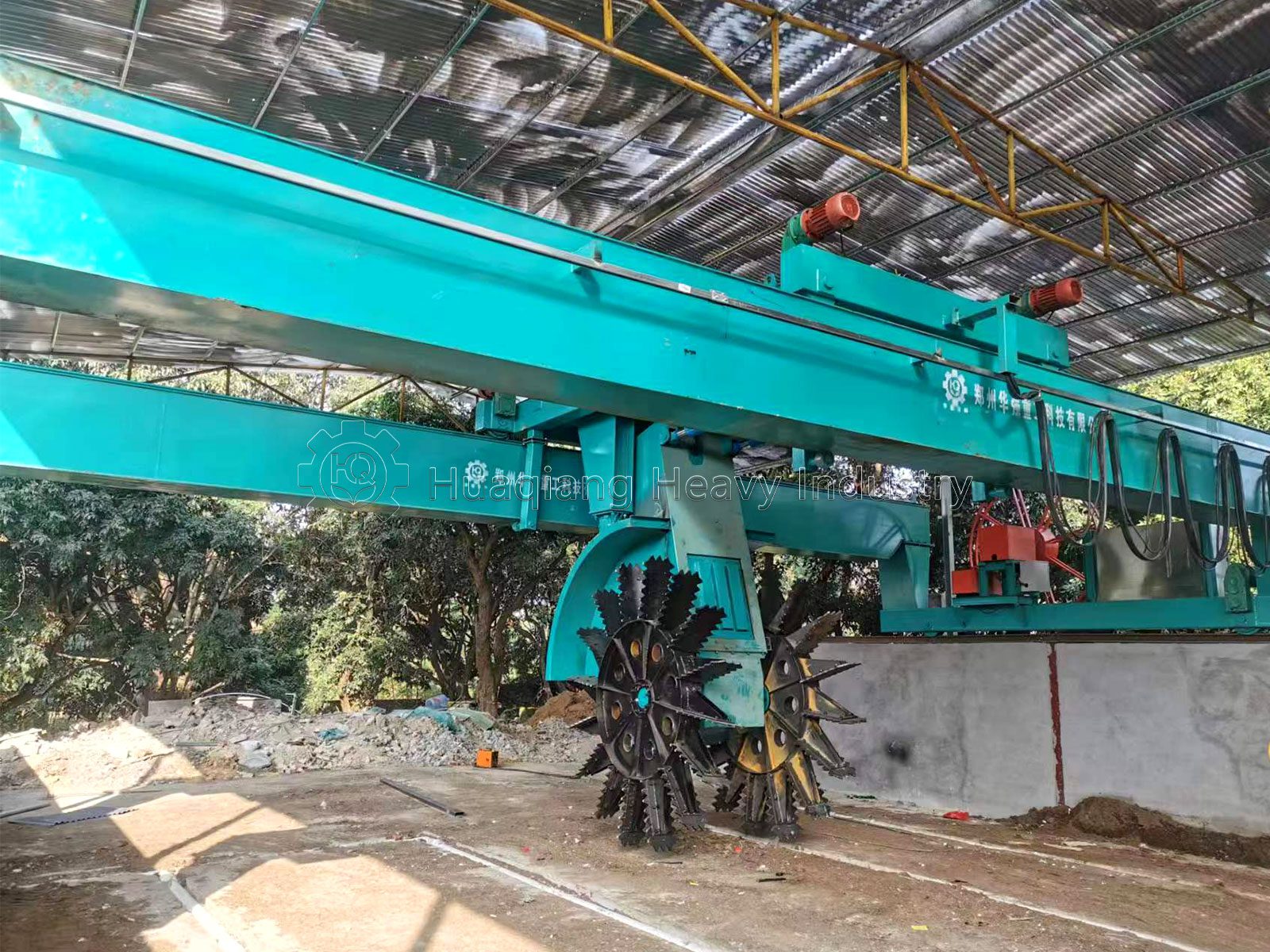

The large wheel compost turning machine is specifically designed for trough-type aerobic fermentation. The matching fermentation tank is the core area for organic fertilizer composting. It is typically constructed of reinforced concrete, ensuring durability, uniformity, and adaptability for reciprocating operation. The length of a single fermentation tank is commonly 30–80 meters, and the tank width, depending on the disc turner model, is available in mainstream specifications of 3 meters, 4 meters, and 5 meters. The tank depth is uniformly controlled at 1.6–2 meters, and the pile height does not exceed 1.5 meters to ensure sufficient oxygen supply for fermentation.
Forced ventilation pipes are pre-embedded at the bottom of the tank, along with an aeration fan. Air is delivered to the bottom of the pile through these pipes, working in conjunction with the turner’s agitation to form a three-dimensional oxygen supply system, accelerating organic matter decomposition and shortening the composting cycle. Straight tracks are cast on both sides of the tank for the large-disc compost turner to move and position itself. The flatness of the tracks directly affects the stability of the equipment’s operation, preventing deviation and abnormal wheel wear.
The entire fermentation tank is treated with waterproofing, seepage prevention, and corrosion resistance. The inner walls are coated with anti-corrosion mortar or a special coating to resist corrosion from manure and biogas slurry, while preventing leachate leakage and environmental pollution. Operating channels and collection ditches are provided between the tanks to collect leachate for recycling, achieving environmentally friendly production in the organic fertilizer fermentation line.
Compared to open-air windrow fermentation, tank fermentation offers stronger sealing, less odor and dust diffusion, and is less affected by rain and snow, allowing for continuous production year-round. Multiple fermentation tanks can be used in separate areas, enabling the efficient flow of raw material feeding, fermentation, and discharging, with seamless process coordination. Regular cleaning of the ventilation holes at the bottom of the tanks is necessary to prevent material blockage affecting aeration, and the tracks should be checked for settlement or deformation to ensure the normal operation of the turning machine.