

In fertilizer production, blending (BB fertilizer), roller extrusion granulation, and bio-organic fertilizer disc granulation are often considered three independent process routes. Many factories choose to perform only one, believing that the three are incompatible. However, in fact, a single pretreatment system can serve multiple production lines simultaneously. The key lies in understanding the differentiated requirements of different processes for material states.
The core of the BB fertilizer production line is “accurate mixing and uniform blending.” The NPK blender uses a twin-shaft paddle structure to uniformly mix granular raw materials such as urea, ammonium phosphate, and potassium chloride within 2-5 minutes, with a uniformity coefficient of variation (CV) ≤ 5%. However, the biggest obstacle to this production line is particle segregation—different raw materials have different particle sizes and specific gravities, which will spontaneously separate during transportation and packaging after mixing. The key to preventing segregation is not in the mixing stage, but in source control—the particle size of all raw materials must be matched. The batching process relies on a multi-bin single-scale static batching system, where each raw material is statically weighed one by one, with an error controlled within ±0.2%.
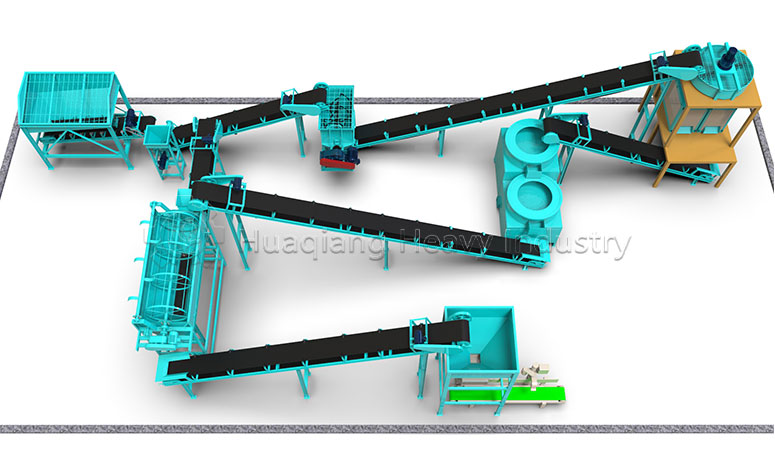
The logic of the roller extrusion granulation line is completely different. This equipment uses a pair of opposing rotating extrusion rollers to directly compress powdered materials into shape under high pressure, belonging to the dry extrusion granulation process. The material is evenly fed into the extrusion zone between the two rollers, formed into flakes or strips under high pressure, and then crushed and granulated to obtain regular granules. The entire extrusion granulation production line requires no water, no drying, and no binder, making it suitable for dry powder materials with a feed particle size of no more than 0.6 mm. It solves a problem that BB fertilizer cannot solve—turning powdered materials into granules with high granule strength, suitable for long-distance transportation. However, roller wear is the biggest operating cost—the roller surface is usually made of high-strength alloy steel with specially shaped grooves to enhance interlocking.
Biological organic fertilizer disc granulation, on the other hand, prioritizes “living.” The core of biological organic fertilizer lies in its large number of active functional microorganisms. These components are extremely sensitive to temperature—high temperatures (>60℃) will cause microbial inactivation. The bio-organic fertilizer disc granulator, with its core “low-temperature granulation” design, ensures a stable temperature of 30-55℃ during the granulation process. For bio-organic fertilizer granulation using Bacillus subtilis as the core, around 45℃ is the optimal temperature, achieving a microbial survival rate of up to 90% and a pelleting rate of 85%-95%. The disc inclination angle can be adjusted to 45°-55° via a hydraulic device, and the rotation speed is controlled at 15-25 r/min. The material is formed through a “rolling-agglomeration” process, avoiding localized high temperatures caused by mechanical extrusion. After granulation, the drying temperature must be strictly controlled to not exceed 60℃; otherwise, the small amount of microorganisms preserved in the initial stage will still die.