

Fertilizer production is often viewed as a continuous flow process, yet in actual operation, the timescales across different stages vary drastically. Fermentation and turning proceed slowly, measured in days, whereas batching and mixing are completed rapidly, measured in seconds or minutes. Understanding these distinct timescales is essential to grasping why equipment cannot be arbitrarily interchanged or managed using the same operational logic.
Fermentation and Turning: A slow process driven by microbial activity. Organic fertilizer fermentation relies on aerobic microorganisms to decompose organic matter—a process that cannot be rushed. Whether using hydraulic turners, windrow turners, large rotary turners, or other fermentation turning machines, the core task is to move material from the bottom of the pile to the surface, allowing oxygen to reach the core while dissipating heat and moisture. Turning frequency is typically measured in days: once every 1–2 days during the high-temperature phase, and once every 3–5 days during the maturation phase. Insufficient turning depth leads to oxygen deprivation at the core, extending the fermentation cycle from 15 days to as long as 60 days; conversely, excessive turning causes rapid heat loss, which also hinders maturation. The “production capacity” of this line depends not on equipment rotation speed, but on the metabolic rate of the microorganisms. Equipment design prioritizes durability, deep turning, and uniform mixing rather than sheer speed.
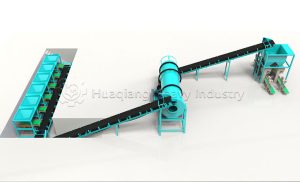
BB Fertilizer Production: A fast process driven by mechanical action. The pace of a BB (Bulk Blend) fertilizer production line is entirely different. A static batching system with multiple silos and a single scale weighs a raw material in seconds, while a BB fertilizer mixer completes a batch in 2–5 minutes. The core of the BB fertilizer mixing process is “shape-preserving mixing”—a twin-shaft paddle structure creates a three-dimensional tumbling motion within the mixing chamber, achieving a coefficient of variation (CV) for uniformity of ≤5% and keeping granule breakage rates below 0.5%. The capacity of this line is determined by batching speed, mixing time, and packaging cycle times—all measured in minutes. Equipment design prioritizes precision, speed, and the preservation of granule integrity. Bio-organic fertilizer granulation involves balancing two distinct timeframes. The disc granulator employs a room-temperature physical forming process; granulation itself is rapid—materials roll on an inclined disc to form pellets within minutes, achieving a pelletization rate of 85%–95%. However, the functional bacteria incorporated during granulation originate from a preceding, lengthy fermentation process. If granulation temperatures exceed 55°C or drying temperatures surpass 60°C, the bacterial strains cultivated through that slow process will suffer massive die-off during the rapid granulation stage. Consequently, the design logic for bio-organic fertilizer production lines is to leverage the efficiency of the rapid process to safeguard the results of the slow process.