

In the acceptance process for fertilizer production lines, the term “compliant” (or “qualified”) is often used as a catch-all. However, in a technical context, compliance for an NPK blending line refers to “recipe integrity,” whereas for a double-roller press granulator, it refers to “particle integrity.” These terms apply to different subjects and cannot be evaluated using the same set of criteria.
For a blending line, compliance means that “every bag matches the recipe.” An NPK blending machine (or bulk blending machine) processes finished granules; the line performs only physical mixing—no granulation, no water addition, and no heating. The quality objective is not to produce granules with specific hardness or roundness, but to ensure that the nitrogen, phosphorus, potassium, and secondary/micro-nutrients remain in the correct proportions within each bag. While a coefficient of variation (CV) of ≤5% for mixing uniformity is an intermediate metric, the ultimate measure is nutrient consistency across different bags. The primary risk here is “segregation”: if there are significant differences in particle size or specific gravity among raw materials, an excess of fine particles, or excessive drop heights during transport, a well-mixed blend can re-separate during discharge and packaging. Therefore, compliance for a blending line must encompass raw material size matching, control of fine particles, and anti-segregation design prior to packaging.
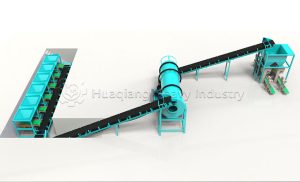
For an extrusion line, compliance means “consistent yield across every batch.” A double-roller press granulator uses a pair of counter-rotating rollers to compress powdered material into dense sheets, which are then crushed and screened into granules. It alters particle morphology through “densification.” Compliance for this line goes beyond meeting granule strength standards; it also requires uniform densification of the compressed sheets, controlled proportions of fines after crushing, and a stable ratio of undersized and oversized material returned to the process (recycled material). A consistently high recycle ratio indicates that the material state or the roller-gap pressure has drifted outside the optimal operating window. This consumes the effective capacity of the granulator and screening equipment with recirculated material, while simultaneously increasing both electricity consumption per ton of product and the wear on the roller shells.
The traceability chains for these two types of lines also differ. The blending line focuses on the “recipe weight chain”—tracking the precise weight of each raw material, the duration of mixing, and whether any stratification occurred prior to packaging. The extrusion line, by contrast, focuses on the “material state chain”—monitoring whether the moisture content and fineness of the incoming feed remain within specified ranges, ensuring the stability of roller gaps and pressure, and verifying that the proportion of recycled material (fines/rework) stays under control. Using the coefficient of variation (CV) from the blending line as a quality benchmark for the extrusion line—or, conversely, using the granule strength from the extrusion line as an acceptance criterion for the blending line—will inevitably lead to an inaccurate assessment of production line capabilities.