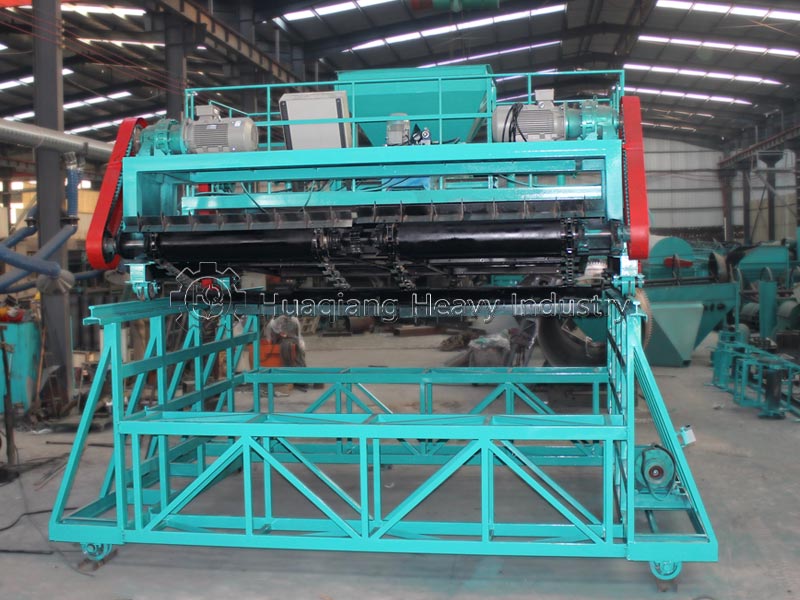

As a core piece of equipment in organic fertilizer production, chain compost turning machines efficiently process agricultural organic solid waste and promote the large-scale bio organic fertilizer production lines. They empower agricultural development from multiple dimensions, including soil improvement, resource recycling, green agriculture, and industrial efficiency, becoming a key tool for connecting agricultural cultivation and livestock farming cycles and achieving green and sustainable agricultural development. The specific contributions are as follows:
- Efficiently disposing of agricultural solid waste and solving the problem of pollution from cultivation and livestock farming. They can quickly turn and ferment livestock manure, straw, mushroom residue, fruit and vegetable residues, and other agricultural organic waste, significantly improving fermentation efficiency (fermentation cycle shortened by more than 60% compared to traditional composting). This achieves harmless and reduced-volume treatment of organic solid waste, solving the problem of soil and water pollution caused by the accumulation of agricultural waste in rural areas, and transforming agricultural waste into a “fertilizer source.”
- Promoting large-scale organic fertilizer production and strengthening the foundation of soil conservation. They enable mechanized and continuous operation of organic fertilizer fermentation, significantly increasing organic fertilizer production capacity and meeting the large-scale demand for high-quality organic fertilizers in agricultural production. Organic fertilizers replace some chemical fertilizers, effectively improving soil compaction, increasing soil organic matter content and water and fertilizer retention capacity, and restoring arable land quality. This addresses the problem of soil degradation caused by long-term single application of chemical fertilizers at its root, ensuring the sustainable use of arable land.
- 3. Lowering the threshold for organic fertilizer production and driving increased agricultural efficiency and income. The equipment is easy to operate and highly adaptable, meeting the production needs of different entities such as large-scale farms, professional cooperatives, and small organic fertilizer processing plants, promoting the standardization and industrialization of organic fertilizer production. It provides low-cost, high-quality fertilizer sources for the planting sector, reducing planting costs, and increases economic income for the livestock farming and straw processing sectors, driving increased efficiency in all aspects of the agricultural industry chain and contributing to rural industrial revitalization.