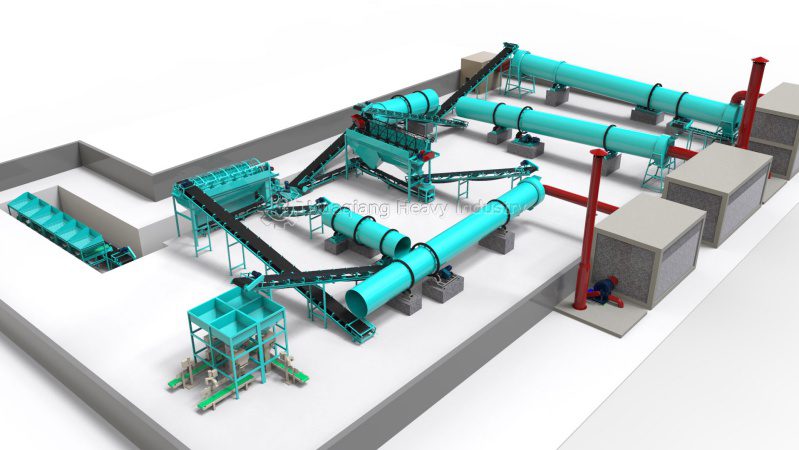

NPK blending fertilizer production lines rely on physical mixing technology, offering flexible formula switching, low investment threshold, and suitability for various fertilizer production and market supply scenarios, with wide application coverage.
The core application is crop cultivation fertilizer production. Nitrogen, phosphorus, and potassium ratios can be adjusted as needed to produce general-purpose fertilizers for field crops such as wheat, corn, and rice. Customized formula fertilizers for fruits, vegetables, seedlings, and medicinal herbs can also be created to meet the nutrient needs of different crop growth stages. Micronutrients, humic acid, and chelated nutrients can be added to produce functional blended fertilizers.
It is suitable for processing diverse raw materials. Conventional single-element fertilizers such as urea, ammonium chloride, monoammonium phosphate, and potassium chloride can be blended. Organic fertilizer granules and biological agents can also be added to produce organic-inorganic compound fertilizers. It has strong raw material compatibility and is not limited by raw material types.
Adaptable to production entities of varying sizes, small-scale units are suitable for township agricultural input processing plants and individual fertilizer workshops, meeting local small-batch production and sales needs; fully automated production lines can support large-scale mass production for medium-sized fertilizer enterprises, accommodating both scattered orders and bulk supply.
Suitable for soil testing and customized fertilizer formulation, these units can quickly adjust the proportions of various raw materials based on soil testing data, producing fertilizers specifically formulated for local soil conditions, meeting the needs of precision agriculture.
Flexible production and sales scenarios, capable of both mass production of conventional fertilizers and accepting customized OEM orders. The equipment has a small footprint, is easy to start and stop, and can handle peak seasonal fertilizer application periods while flexibly shutting down for maintenance during off-seasons. Products are widely sold to agricultural input stores, planting bases, and cooperatives, and are suitable for various fertilizer application scenarios such as farmland fertilization, garden maintenance, and greenhouse cultivation.