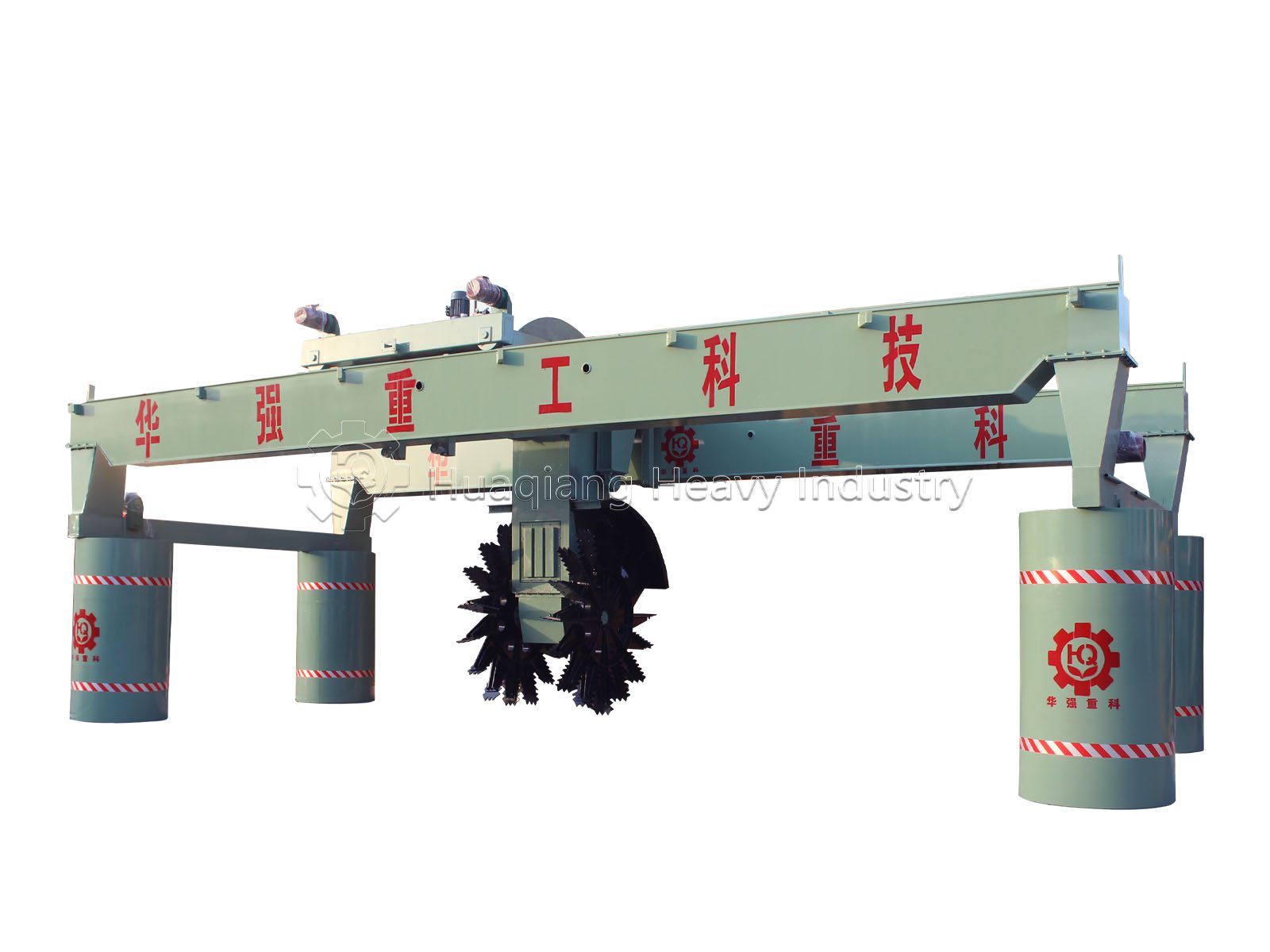

The large wheel compost turning machine is specialized equipment designed for large-scale channel-type fermentation. It operates by traveling longitudinally along rails on both sides while using a rotary disc for transverse turning and aeration. Consequently, the civil engineering of the fermentation channels, rails, ground surface, spatial clearance, and drainage systems must meet standardized, rigorous specifications; these factors directly determine the fermentation compost turning machine‘s operational stability and the effectiveness of the composting process.
Fermentation channel dimensions must align with the equipment’s span. Mainstream models accommodate channel widths of 8–30 meters, wall heights of 2–3 meters, and material pile heights of 1.5–2.5 meters. A single channel must be at least 30 meters long, with large-scale projects typically featuring lengths of 50–200 meters. Channel partition walls must meet load-bearing standards and stand perfectly vertical (without leaning) to prevent the equipment from shifting laterally and scraping against the walls. The channel floor must be fully paved with reinforced concrete at least 15 cm thick, with surface flatness controlled to within ±3 mm. A slight longitudinal slope of 1‰–2‰ is required, accompanied by leachate collection drains, to prevent water and sludge accumulation that could trigger anaerobic fermentation or corrode the rails.
The rail system serves as the core foundation. Specialized steel rails are laid along both sides of the channels; the rail gauge must strictly match the equipment’s wheel assembly, horizontal deviation must not exceed ±3 mm, and anchor bolts must be securely embedded without looseness. Maintenance walkways (0.8–1.2 meters wide) must be reserved on both sides of the rails to facilitate equipment maintenance and personnel access. Multi-channel layouts require space for equipment transfer to enable a single machine to operate across multiple channels.
There are specific limits regarding site load-bearing capacity and slope. The rail foundation requires a bearing capacity of at least 2 t/m²; soft soil foundations necessitate an additional steel reinforcement layer. The overall site slope must not exceed 3°; excessive slope can cause the equipment to drift off-track and result in uneven turning depths. For outdoor sites, the construction of a rain shelter is recommended to prevent rainwater from increasing the material’s moisture content and causing rust on the travel drive components. Regarding spatial requirements, the workshop’s clear height must exceed the equipment’s highest point by at least one meter to facilitate the lifting and maintenance of the rotating disc. The site layout must designate specific zones for raw material storage, fermentation tanks, and finished product discharge, while also reserving access lanes for forklift transport. Obstructions such as protruding pipelines or stones are prohibited within the area to prevent damage caused by high-speed rotating disc blades; additionally, provisions must be made for embedding ventilation and aeration piping to meet aerobic fermentation oxygen requirements. Once the site construction is complete, the track level must be calibrated before equipment installation and commissioning can proceed.