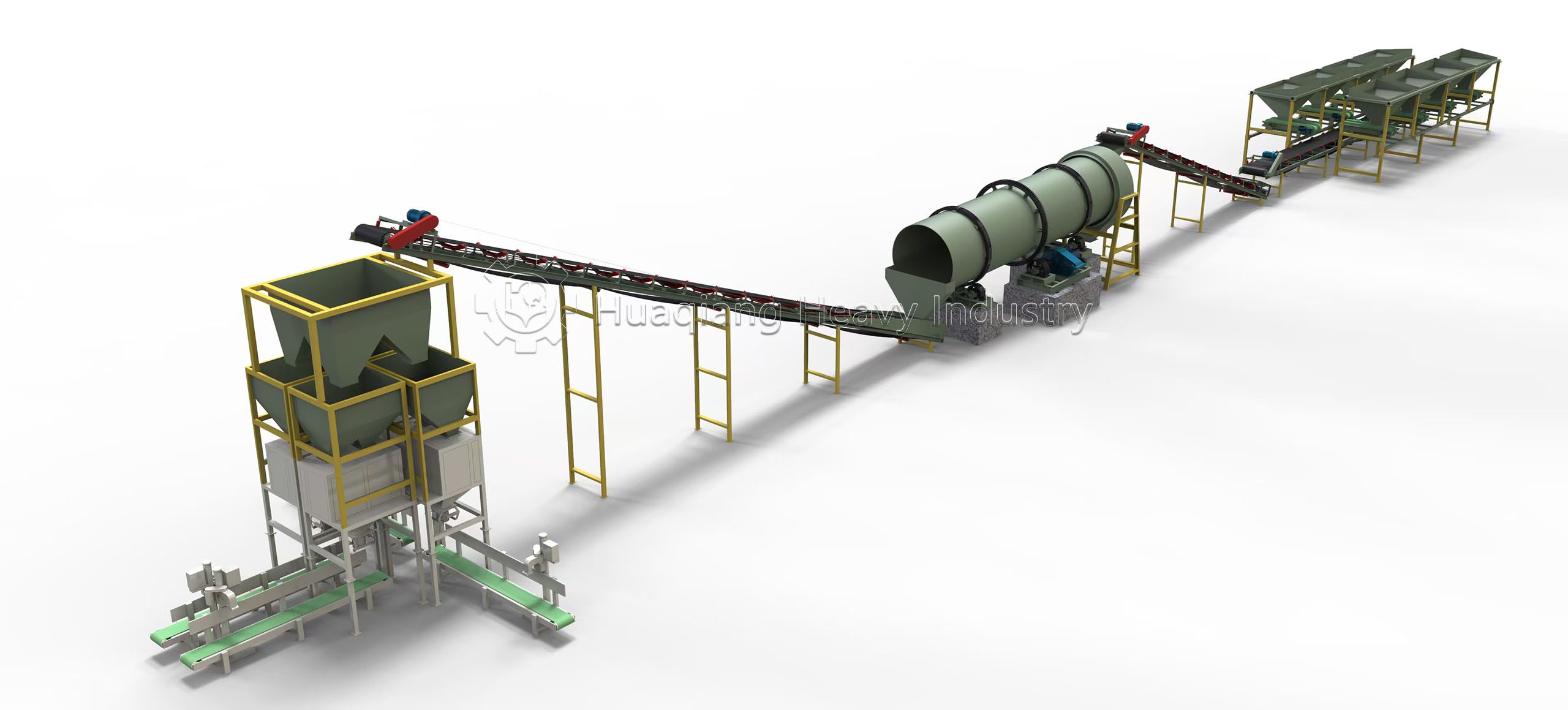

NPK blending fertilizer production lines do not require fermentation, granulation, or drying stages, resulting in lower civil engineering requirements; however, they are subject to specific site constraints regarding equipment installation, raw material storage, environmental compliance, and safe operation and maintenance, all of which directly impact production stability and environmental impact assessment (EIA) approval.
There are strict standards regarding spatial dimensions and ceiling height. Factory buildings for small-scale lines require a ceiling height of at least 3.2 meters, while medium-scale lines require no less than 4 meters to ensure the proper installation of vertical batching silos and conveying equipment, as well as to provide clearance for overhead maintenance and material loading. The workshop layout must be orderly and open, with access aisles at least 3 meters wide to accommodate forklifts and trucks; cramped conditions can lead to material spillage and hinder NPK bulk blending machine maintenance, making continuous automated production impossible.
The flooring must be hardened to high standards with impermeable surfacing and a load-bearing capacity exceeding 3 tons/m². Foundations for batching silos, mixers, and packaging machines require reinforcement and leveling to ensure a flat surface free from subsidence. Constructing the plant on soft ground or in low-lying, water-prone areas is strictly prohibited; such conditions can cause weighing sensor inaccuracies—leading to batching errors and nutrient content deviations—and allow accumulated water to dissolve fertilizer and erode the floor, creating risks of caking and dust generation.
The site environment must meet moisture-proofing and ventilation requirements. Since urea and potash fertilizers are highly hygroscopic and prone to caking, the plant must avoid low-lying, damp, or groundwater-seepage areas and be equipped with ventilation and dehumidification systems to keep the workshop dry. Additionally, as production generates minor amounts of dust, the site should not be immediately adjacent to residential areas or schools; space must be reserved for dust extraction ductwork, and airtight dust-control measures implemented to mitigate the risk of environmental complaints and mandatory rectification orders.
Utility infrastructure must meet standards; the plant requires a stable 380V industrial power supply, with waterproof and grounding measures in the electrical control area to ensure the stable operation of automated batching systems. Drainage channels must be installed to collect wastewater from equipment cleaning and floor washing, preventing water accumulation and dampness. Furthermore, the site must be clearly divided into raw material, production, and finished product zones with segregated layouts to prevent cross-contamination, thereby ensuring formula precision and stable, compliant production.