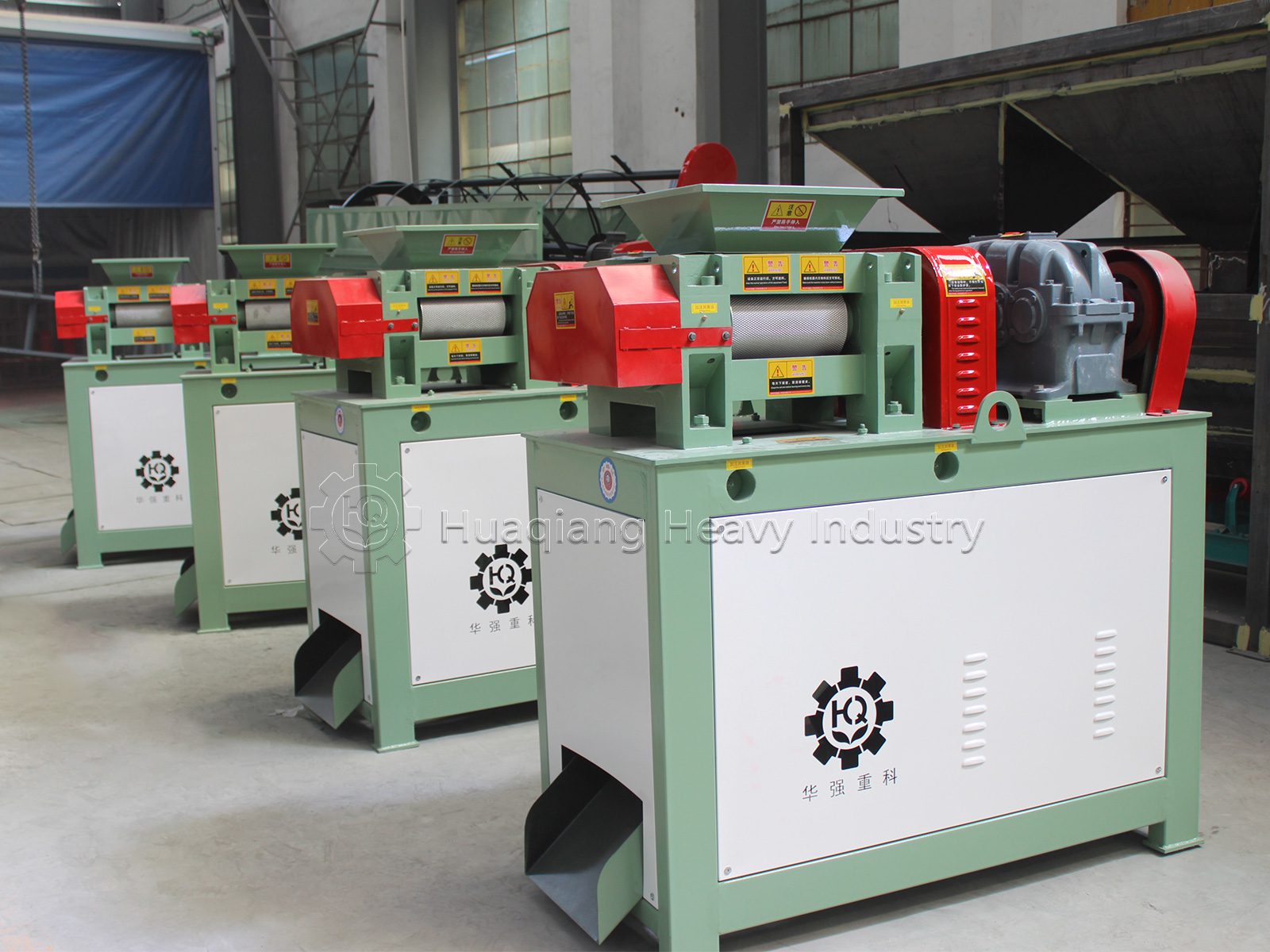

The primary causes of granule adhesion in roller press granulator production lines include excessive raw material moisture, material buildup in the roll die holes, improper extrusion pressure, and moisture re-absorption during post-discharge stacking. Addressing this requires simultaneous, multi-dimensional control across raw material pretreatment, main machine adjustment, discharge conveyance, and auxiliary processes.
Precise control of raw material moisture is fundamental. For organic fertilizer, the optimal moisture content is 22%–28%; excessive moisture makes the material too plastic, resulting in soft granules that stick together upon stacking, while low moisture makes granules brittle. Small amounts of bentonite or humic acid can be added to enhance toughness, avoiding the need for excessive water supplementation. Wet raw materials should be evenly mixed in a twin-shaft mixer and pre-dried to remove wet clumps. Materials must be covered to prevent moisture absorption on rainy days and screened before storage to remove large, damp chunks, thereby preventing localized moisture imbalances that cause sticking to the rolls or granule adhesion.
Optimize the operating parameters of the fertilizer roller press granulator. Increase the gap between the two pressure rolls to reduce extrusion density and internal granule moisture content. For hydraulic models, moderately lower the extrusion pressure to prevent the material from being compressed into thin, sticky flakes. Regularly clean the roll die holes; fertilizer buildup on the inner walls makes demolding difficult and causes granules to stick together in strips. Use a steel wire brush to clear accumulated material from the die holes after shutdown, and apply an anti-stick coating to the roll surface to reduce material adhesion. Reduce the speed of the variable-frequency feed screw to ensure a uniform, low-volume feed; moderate die-hole filling prevents granules from sticking together due to overfilling.
Improve the discharge, conveying, and cooling processes. Freshly formed wet granules are hot and sticky and should not be stacked directly; minimize the discharge drop height and install buffer deflectors to reduce granule compression and stacking. Immediately transfer discharged granules to a rotary cooling and screening machine; low-temperature airflow rapidly removes surface moisture and reduces surface tackiness. Moderate screen vibration helps separate stuck granules, while fine powder is recycled for re-extrusion. Install belt scrapers on the conveyor system to prevent material buildup and adhesion of fresh granules to the belt.
Implement supporting controls for daily operation and maintenance. Clear out residual wet material from the equipment at the end of each shift to prevent hardening or clumping that could disrupt the next day’s production. During production breaks, periodically purge material adhering to the roller surfaces and feed hoppers. Incorporate appropriate amounts of talc or light calcium carbonate into the formula as anti-sticking agents to reduce inter-granular adhesion. Avoid continuous, long-term processing of wet materials with high salt or organic content; instead, schedule intermittent shutdowns to clean the roller surfaces, thereby eliminating the root causes of sheet-like adhesion and elongated, fused defective granules.