

When expanding production, many fertilizer plants face a critical decision: are the raw materials ready-made granules or powders requiring processing? This seemingly simple question directly determines whether to install an NPK blending line or a roller press granulation line. These two routes differ vastly in equipment configuration, process logic, and cost structure; a wrong choice can make every subsequent step problematic.
If the raw materials are finished granules—such as urea, diammonium phosphate (DAP), or potassium chloride—an NPK blending line is the more pragmatic choice. This line has only two core tasks: accurate weighing and thorough mixing. The blending unit employs a multi-bin static weighing structure where each raw material is weighed individually, keeping batching precision within ±0.2%. The mixing stage relies on low-speed convection, causing granules of varying densities to repeatedly shift positions within the drum, resulting in a mixing uniformity coefficient of variation consistently below 5%. The entire line eliminates the need for granulation, drying, and cooling; it requires a small footprint and offers rapid startup, making it ideal for blending stations that frequently switch formulas. However, there is a prerequisite: the raw materials must be high-quality granules, ideally with particle size differences kept within 1 mm; otherwise, vibration during transport can lead to secondary segregation.
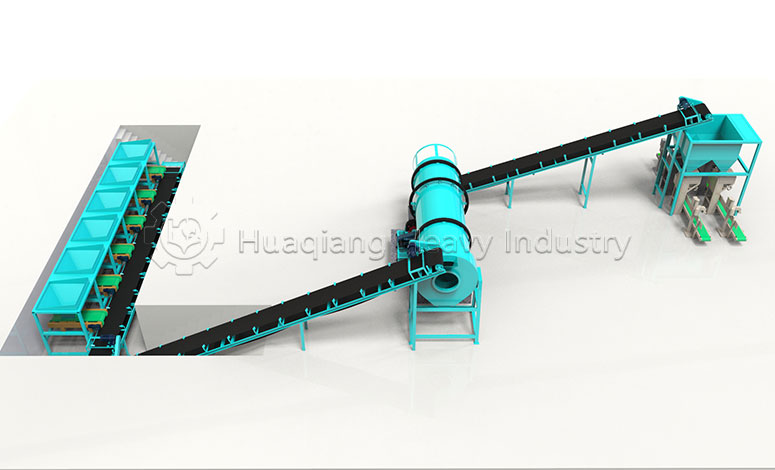
If the raw materials are in powder form, or if you wish to control the shape and strength of the granules yourself, a double-roller press granulator is the core piece of equipment. It operates on the principle of dry high-pressure extrusion: two counter-rotating rollers compress the powder into a sheet at ambient temperature, which is then crushed and screened into granules. The process requires no water and generates no heat; with a raw material moisture content of only 5% to 10%, it eliminates the drying and cooling systems essential to wet granulation, reducing overall energy consumption by over 40%. As the most widely used model in the fertilizer roller press family, it is particularly well-suited for urea-based formulas, as urea is prone to deliquescence (absorbing moisture and liquefying) upon contact with water, making wet granulation unfeasible. Although the extruded granules bear surface indentations, they are dense and strong; after resting for 24 hours, their compressive strength exceeds 20 N, ensuring minimal pulverization during loading and transport.
In practice, these two approaches are not mutually exclusive. Many factories operate both extrusion and blending lines: low-cost powders are first processed into granular base material via roller compaction, which is then combined with other finished granules according to a specific formula on the blending line. This strategy controls raw material costs while maintaining formulation flexibility. The key to choosing a production line lies not in which technology is more advanced, but in the source of your raw materials, your target market, and the electricity costs your budget can sustain. Accurately assessing the initial state of your raw materials before determining the process route is far more reliable than blindly pursuing an “all-purpose” production line.