

A common misconception in fertilizer procurement is to compare double-roller press granulators and NPK blending production lines—evaluating them side-by-side based on price or capacity as if they were interchangeable options. In reality, these two types of equipment occupy different positions within the fertilizer value chain: one is designed to “turn powder into granules,” while the other is designed to “blend granules into finished fertilizer.” Understanding this functional distinction is far more meaningful than simply comparing individual machine specifications.
The double-roller press granulator is the core equipment for the “granulation” stage. It processes powdered raw materials, using two high-strength, counter-rotating rollers to compress the powder into dense sheets at ambient temperature, which are subsequently crushed and screened into granules. This process requires no water and no external heat; the granules are held together by natural molecular-level forces, such as van der Waals forces, adsorption, and crystalline bridges. As a “dry” granulation method, it eliminates the need for the drying and cooling systems required in “wet” granulation, resulting in significantly lower energy consumption. The resulting granules are highly dense and robust, making them well-suited for long-distance transport and repeated handling. This process addresses the challenge of transforming loose powder into a commercially viable, granular form—serving as an upstream operation for granulation plants, compound fertilizer facilities, and organic fertilizer producers.
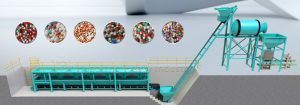
Conversely, an NPK blending production line is the core of the “fertilizer blending” stage. It processes pre-existing, finished granules—such as urea, diammonium phosphate (DAP), and potassium chloride—without altering the chemical composition of any raw material; its sole purpose is precise formulation. Within this line, NPK bulk blending equipment performs the mixing function, utilizing a multi-bin, static weighing system. Each raw material is weighed individually before being discharged into the mix, allowing for a formulation precision of within ±0.2%. The mixing process relies on low-speed convection, which causes granules of varying bulk densities to shift positions repeatedly, all while keeping granule breakage to a minimum. This type of production line addresses the need for flexible, responsive formulation—making it ideal for fertilizer blending stations, agricultural service centers, and regional, custom-fertilizer production facilities. There is a clear upstream-downstream relationship between these two production routes. Granules produced by an extrusion granulator can serve as raw material for a blending line, where they are combined with other finished granules according to specific formulas to create specialized fertilizers tailored to different crops and soil types. In other words, an extrusion granulator is equipment for a “granulation plant,” while a blending line belongs in a “fertilizer blending station”—they serve different types of clients and operate on different production cadences. Extrusion lines are designed for high-volume, continuous production of a single formula, requiring stable, uninterrupted operation. Blending lines, by contrast, are suited for small-batch production with frequent formula switching; transitioning from, say, rice fertilizer today to vegetable fertilizer tomorrow requires only a few numerical adjustments in the control system.
When selecting equipment, the key is not to determine which route is “more advanced,” but rather to identify where you sit within the industrial supply chain. If you are starting with powdered raw materials and need to create granules from scratch, a double-roller press granulator is the essential starting point. If, however, you are working with finished granules and need to fulfill orders based on specific formulas, an NPK blending fertilizer production line is the appropriate tool. Each route fulfills a distinct function, and together, they form a complete fertilizer supply chain—from raw materials all the way to the field.